

Introduction
Hansi Flick, a renowned German football manager, has earned recognition for his tactical insight and the strategic changes he has made to adapt to different teams. His successful tenure at Bayern Munich highlights his tactical philosophy and innovative approach. This article explores his football philosophy and examines the key tactical changes he made when managing both the German national team and FC Barcelona.
Hansi Flick’s Football Philosophy
Flick’s football philosophy blends traditional German football principles with his own innovative approaches. The core of his strategy includes high pressing, quick transitions, and positional play. Here are the key components of his football philosophy:
- High Pressing and Gegenpressing:
Flick’s teams are known for aggressive high pressing, often implemented as Gegenpressing (counter-pressing), a strategy Flick learned from his time as assistant to Joachim Löw with the German national team. His teams aim to regain possession immediately after losing the ball, forcing the opposition into mistakes and disrupting their build-up play. - Positional Play and Tactical Fluidity:
Flick emphasizes positional play (using space strategically), which focuses on players maintaining optimal positions to create passing lanes and options. His teams are required to be tactically fluid, adapting to changing situations while maintaining structure. This allows them to control the game and dominate possession. - Direct and Quick Transitions:
Flick prefers direct, quick passes that enable his team to transition from defense to attack at pace. The transition is often direct, utilizing the width of the pitch, with wingers staying wide to stretch the opposition. This style is particularly evident in his Bayern Munich teams, where counter-attacks were fast and lethal. - Wing Play and Full-Back Overlaps:
Flick places significant importance on wing play and full-back overlaps to stretch the opposition and create space for attackers. Full-backs are tasked with providing width in attack, often overlapping the wingers to deliver crosses or create space by cutting inside.
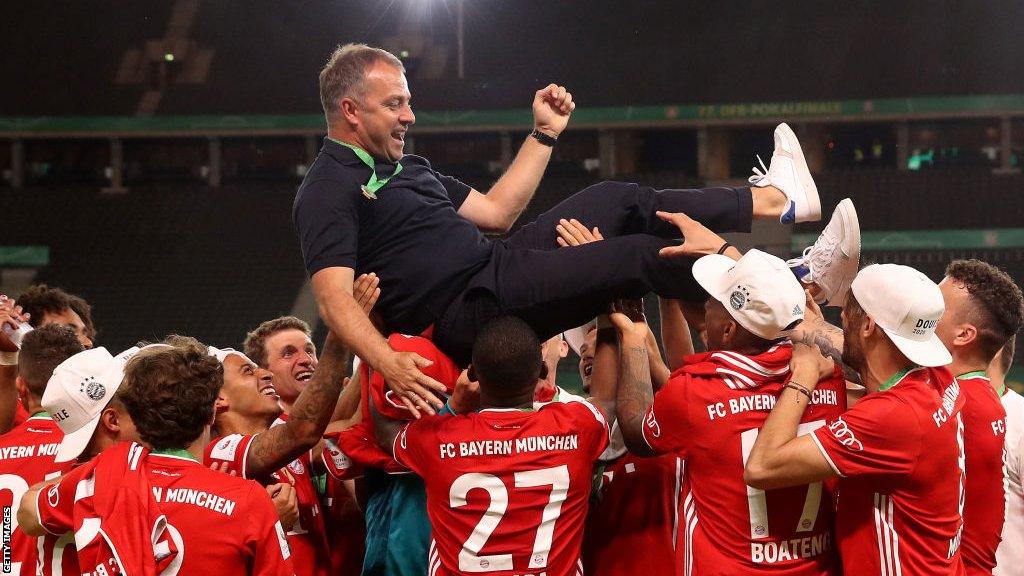
Flick’s Tactical Shift at Bayern Munich
When Flick took over at Bayern Munich, he transformed the team into a dynamic, fast-paced unit. One of the defining features of his time at Bayern was the ‘Bayern Gegenpress’, which saw the team pressing aggressively after losing possession, often trapping the opposition in their own half. This style led to Bayern’s success, including the 2020 UEFA Champions League title.
- Formation and Personnel:
Flick often used a 4-2-3-1 formation, with the defensive midfield pairing of Joshua Kimmich and Leon Goretzka controlling both attack and defense. The attacking quartet of Serge Gnabry, Thomas Müller, Kingsley Coman, and Robert Lewandowski formed a devastating front four capable of fast, efficient attacks. - Positional Play and Full-Back Overlaps:
Bayern’s full-backs, notably Alphonso Davies and Joshua Kimmich, played a crucial role in the attacking setup. They would overlap the wingers, creating width, while Müller and Lewandowski operated centrally, making late runs into the box.
Flick’s Tactical Changes with the German National Team
Upon taking over the German national team, Flick aimed to rejuvenate the squad after their disappointing 2018 World Cup exit and the lackluster performances in UEFA Euro 2020. Here, he introduced a more structured and efficient system, maintaining elements from his Bayern days but with a few tweaks to suit the national team’s needs.
- Flexible Formations:
Flick often deployed a 4-3-3 or 4-2-3-1 formation, using wingers to stretch the opposition. One major change was focusing on a more compact defensive structure, ensuring that Germany remained solid while maintaining their attacking prowess. - Pressing and Counter-Attacking:
As with Bayern, Flick introduced high pressing at the national level, aiming to win the ball back quickly after losing it. This allowed Germany to launch rapid counter-attacks, relying on the pace of players like Leroy Sané and Serge Gnabry. - Positional Play and Role Switching:
Germany’s attacking play under Flick was more fluid, with players frequently switching positions to overload the midfield and create space. Thomas Müller continued to play as a Raumdeuter, moving between the lines to exploit defensive weaknesses.
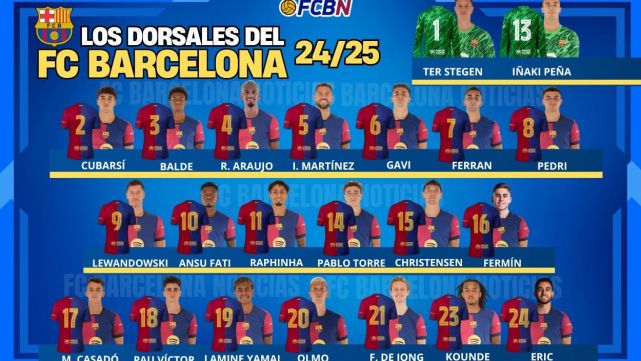
Flick at FC Barcelona: A New Tactical Challenge
Flick’s potential move to FC Barcelona marks a new chapter in his managerial career, where he would need to balance his tactical philosophy with Barcelona’s traditional tiki-taka style of possession-based football. While his approach remains largely unchanged, Barcelona’s system focuses more on controlled possession and intricate passing. However, in 2025, FC Barcelona has evolved with the emergence of young La Masia talents, adopting a more active and flexible style of football.
Specifically, in midfield, Gavi, Pedri, and Olmo have become key players, dominating games with their quick passing and ability to break through the opposition’s defense. Up front, Raphinha, Yamal, and Lewandowski are showing exceptional attacking form, driving the team’s offensive play with speed and precision. These attacking players are executing Flick’s tactical fluidity, moving quickly and efficiently to create chances.
- Possession and Control:
Barcelona continues to maintain its traditional tiki-taka style but with added elements from Flick’s tactics. There is now an emphasis on quick transitions and direct attacking, which allows Barcelona to change the pace of the game rapidly and break down the opposition’s defense more effectively. - Wing Play and Full-Back Roles:
Barcelona’s full-backs continue to play crucial roles, helping transition the ball quickly and providing width in attack. The young full-backs are increasingly involved in overlapping runs with wingers, stretching the defense and creating more attacking opportunities. - Tactical Flexibility with Young Talents:
The young La Masia talents, such as Pedri, Gavi, and Olmo, are perfectly suited to Flick’s tactical flexibility, excelling in high pressing and fast transitions. These players are crucial in the fluid attacking play that Flick’s system requires, while also showing creativity and speed to disrupt opposing defenses. Additionally, Raphinha, Yamal, and Lewandowski have formed a lethal attacking trio, contributing greatly to Barcelona’s offensive output.
Conclusion: The Tactical Evolution of Flick
Flick’s tactical approach has evolved from Bayern Munich to the German national team and potentially to FC Barcelona, with each transition reflecting his adaptability and tactical brilliance. His emphasis on high pressing, quick transitions, and positional play remains consistent, but he tailors his strategies to suit the specific needs of each team.
At Bayern Munich, Flick’s style was defined by rapid counter-attacks and high pressing, while with Germany, he introduced a more balanced approach. At Barcelona, he is blending the club’s traditional possession-based philosophy with his own tactics to create a more active and fluid style of play. The young La Masia talents have fully adapted to Flick’s system, delivering faster, more direct football, especially in midfield, where Gavi, Pedri, and Olmo have excelled. Meanwhile, in attack, Raphinha, Yamal, and Lewandowski continue to showcase impressive performances, making Barcelona a formidable force in both La Liga and the Champions League.

 VIKING BARCA