
Barcelona Femení’s Dynasty: How the Blaugrana Became the Gold Standard of Women’s Football
An empire built on trophies, positional play, and a midfield partnership that has defined an era.
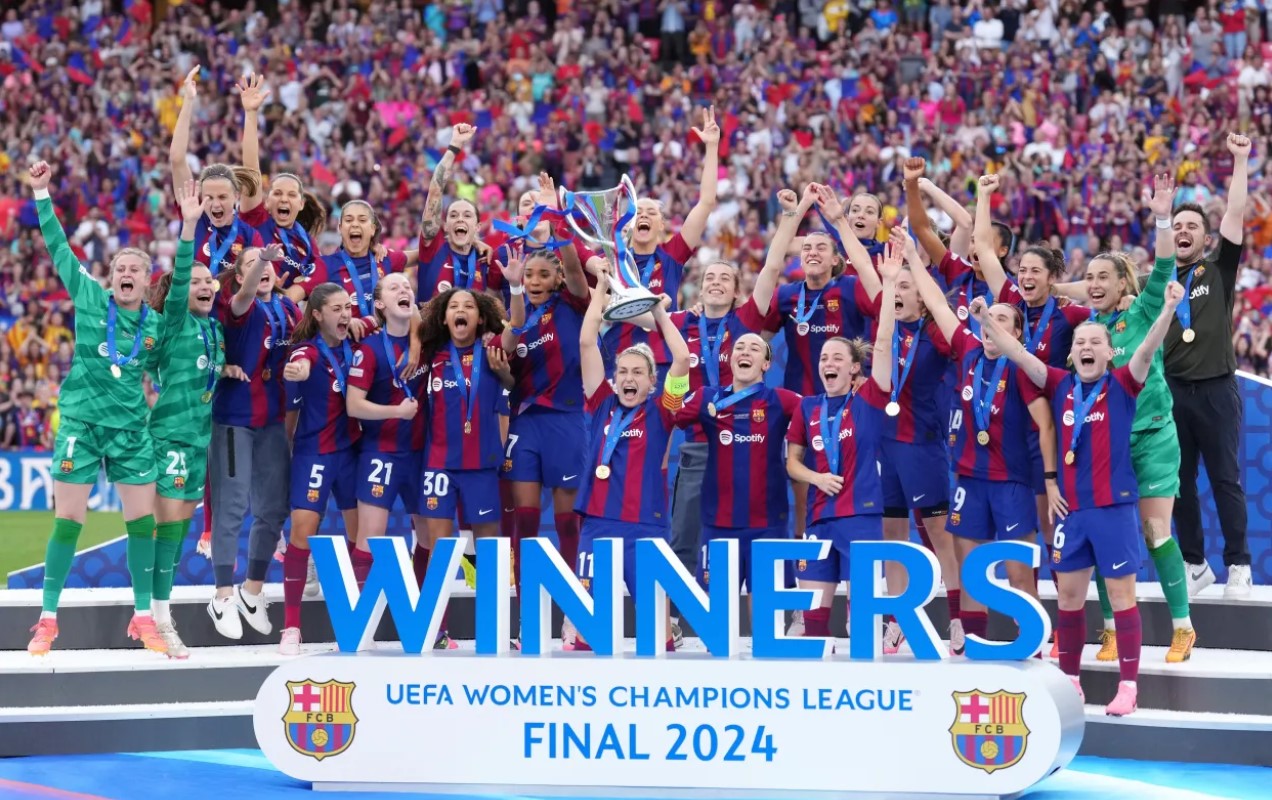
FC Barcelona Femení are no longer merely the dominant force in Spain; they are the benchmark by which the modern women’s club game is judged. According to Barcelona’s official honours list, the club has won 10 league titles, 11 Copas de la Reina and three UEFA Women’s Champions League titles, with the latest Liga F crown in 2024–25 extending their domestic supremacy into a sixth straight league championship. UEFA’s competition records also confirm Barcelona’s European titles in 2021, 2023 and 2024, with a runners-up finish in 2025 after a 1–0 defeat to Arsenal in Lisbon.
The numbers are imposing, but the deeper story is stylistic. Barcelona have built a dynasty not through reactive football or isolated star turns, but through an obsessive commitment to structure: positional play, controlled possession, territorial suffocation and immediate counter-pressing after loss. The continuity of that model has survived a coaching transition as well. Barcelona’s official staff profile notes that Pere Romeu became head coach in July 2024 after serving as Jonatan Giráldez’s assistant during one of the most successful cycles in the club’s history, which helps explain why the team still looks ideologically coherent rather than newly assembled.
In tactical terms, Barcelona are still the clearest women’s-game expression of the club’s historical football identity. UEFA’s technical and tactical coverage of Barça’s recent Champions League campaigns has repeatedly highlighted the side’s command of possession, their midfield overloads, and the way they use circulation not as decoration but as a weapon. Their passing volume, patient probing and aggressive pressing without the ball make them difficult to live with for any opponent, even when those opponents succeed in reducing the margin of defeat.
Barcelona Femení: Major Honours Snapshot
Competition/ Titles/ Most Recent Winning Season(s)
| Liga F / Women’s League | 10 | 2024–25 |
| UEFA Women’s Champions League | 3 | 2023–24 |
| Copa de la Reina | 11 | 2024–25 |
Source basis: FC Barcelona official honours page; UEFA Women’s Champions League records.
What Barcelona’s Football Looks Like
Barcelona’s game begins with control, but it does not end there. Their structure usually places the midfield at the center of every attacking sequence: one player stabilizes circulation, one dictates tempo and occupation of interior zones, and one breaks lines with carries or late arrivals. Full-backs and wingers stretch the field, half-spaces are constantly attacked, and the team’s pressing shape ensures that lost possession often becomes a temporary interruption rather than a genuine defensive phase. That is why Barça can appear both elegant and oppressive at the same time.
This is where Alexia Putellas and Aitana Bonmatí become central to the story. Their individual awards are not just ornaments; they are evidence of Barcelona’s tactical ecosystem producing, and being sustained by, two different forms of elite midfield control. France Football’s official Ballon d’Or palmarès confirms that Putellas won the Women’s Ballon d’Or in 2021 and 2022, while Bonmatí won it in 2023, 2024 and 2025. Barcelona’s own coverage of Bonmatí’s 2025 triumph described the remarkable sequence plainly: the best women’s player in the world has come from Barça for five consecutive award cycles.
Putellas vs. Bonmatí: Comparative Analysis
Category/ Alexia Putellas/ Aitana Bonmatí
| Ballon d’Or record | Winner in 2021, 2022 | Winner in 2023, 2024, 2025 |
| Core identity | Orchestrator, controller, final-third conductor | Accelerator, line-breaker, destabilizer |
| Best qualities | Tempo control, chance creation, timing, composure | Press resistance, ball-carrying, progression, dynamism |
| Attacking profile | Arrives late, combines elegantly, scores with intelligence | Drives through pressure, attacks gaps early, creates momentum |
| Tactical effect | Makes Barcelona calmer, more measured, more deliberate | Makes Barcelona sharper, quicker, more vertical |
| Symbolic role | The brain | The engine |
Awards basis from France Football official palmarès and UEFA/club coverage of Bonmatí’s 2025 award.

Alexia Putellas: The Architect
Putellas’ greatness lies in the authority of her football. She is the player who gives Barcelona shape when matches threaten to become untidy. Her game is built on scanning, rhythm, timing and interpretation of space. She slows the match when Barcelona need composure, speeds it up when the opening appears, and remains a scoring threat despite operating from midfield zones. Putellas is not merely creative; she is governing. In a side built on positional intelligence, she often looks like the player reading the next page before anyone else.
At her peak, Putellas has embodied the classical Barcelona interior: technically secure, constantly available between lines, and capable of transforming sterile possession into decisive attacking sequences. She does not need chaos to dominate a match. She prefers order, then weaponizes it.

Aitana Bonmatí: The Accelerator
Bonmatí, by contrast, is the midfielder who changes the temperature of a game. UEFA’s report on her 2025 Ballon d’Or win framed the award around another season of elite influence for club and country, and that is consistent with how she plays: she receives under pressure, escapes it, and turns escape into attack almost immediately. Her most distinctive quality is not simply technique, but progressive violence in movement — the ability to deform a defensive block by carrying through it.
Where Putellas often arranges the game, Bonmatí frequently ruptures it. She is more vertical in feel, more combustible in motion, and more likely to convert a harmless-looking sequence into a numerical or spatial advantage within seconds. If Putellas is the architect of Barcelona’s rhythm, Bonmatí is the midfielder who makes the geometry collapse.
Tactical Verdict: Why Barcelona Remain the Standard
Barcelona’s greatest strength is not that they possess world-class talent; many elite teams do. It is that their talent fits a repeatable, high-clarity model. They can dominate with possession, but they are not prisoners of possession. They can construct patiently, but they also have midfielders who can accelerate. They can pin opponents deep, then suffocate any attempted escape with their press. When the system is functioning, the opposition are forced to defend not only the ball, but the spaces they are being manipulated into abandoning.
The one caveat is that such an assertive model carries risk. A team that commits numbers high and monopolizes territory can be vulnerable when the first press is beaten or when a disciplined opponent survives long enough to punish isolated transition moments. The 2025 Champions League final loss to Arsenal was a reminder that even the most polished positional sides can be denied if control does not become clinical edge. Yet that defeat did not weaken Barcelona’s broader standing. It reinforced the standard they have already set: even their setbacks are measured against the expectation that they should be the team defining the game.
Barcelona Femení’s era has therefore become about more than trophies. The silverware confirms their greatness, but the style explains it. Putellas and Bonmatí, different in texture but equally elite in influence, are the clearest symbols of that story: one bringing command, the other rupture; one dictating the match, the other tilting it irreversibly. Together, they have helped make Barcelona not just champions, but the modern reference point in women’s football.

 VIKING BARCA