
Here’s a systematic English version of the content you wrote about Lionel Messi’s dribbling biomechanics, organized as a professional sports science report:
Lionel Messi’s Dribbling Biomechanics: A Scientific Analysis
1. Overview
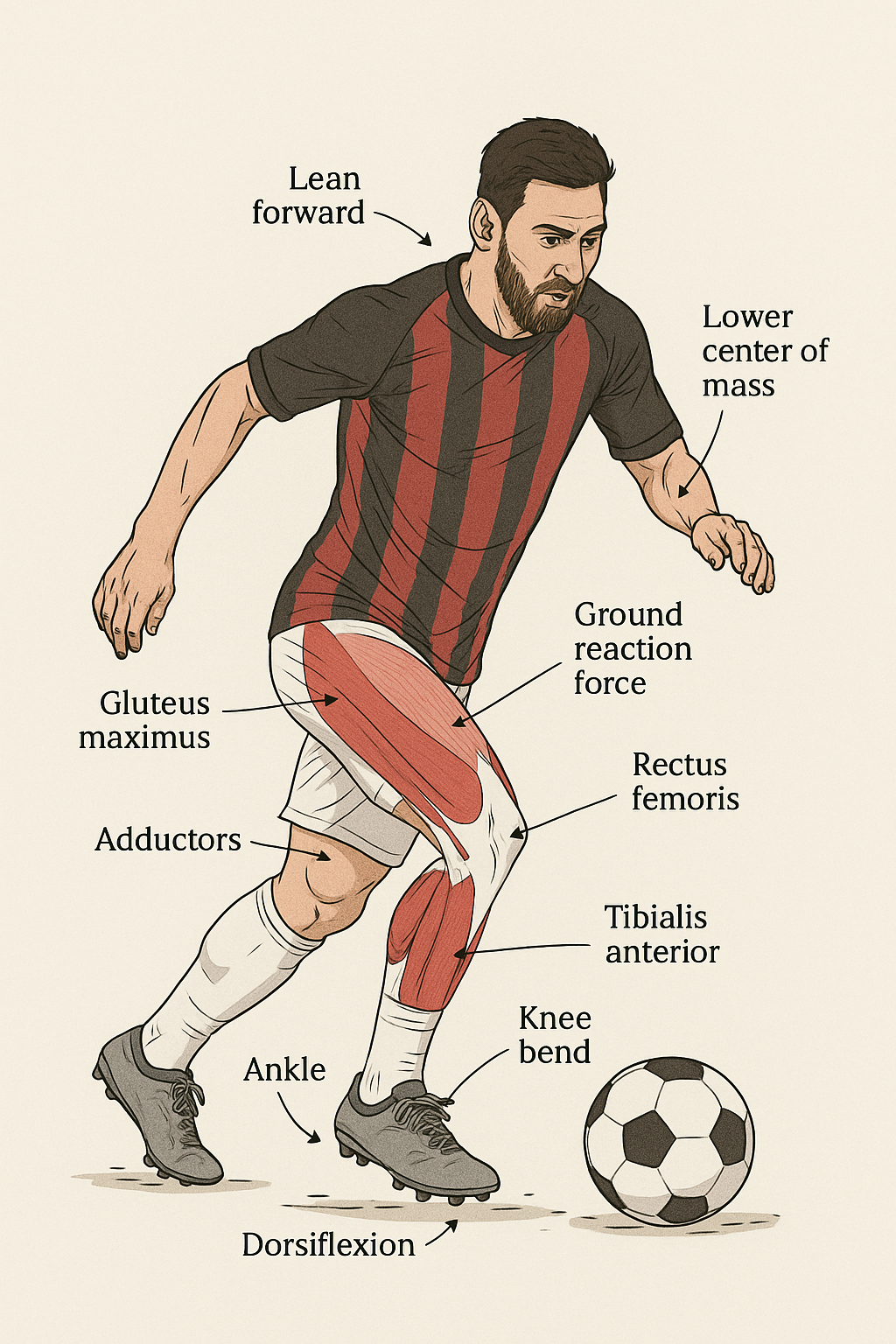
Lionel Messi’s dribbling exemplifies biomechanical efficiency and neuromuscular precision. His movement can be divided into three sequential phases governed by kinetic chain coordination: Preparation, Direction Change, and Propulsion.
2. Movement Phases and Muscle Activation
| Phase | Key Movements | Primary Muscles Involved | Functional Purpose |
|---|---|---|---|
| 1. Preparation Phase | Lowering center of gravity, stabilizing stance, ankle dorsiflexion | Quadriceps, Gastrocnemius, Tibialis anterior | Establishes stability and pre-loads muscles for directional unpredictability |
| 2. Direction Change Phase (Cutting) | Hip adduction/abduction, knee flexion, ankle plantarflexion | Adductors (longus, magnus), Gluteus maximus, Hamstrings, Soleus | Shifts body weight and redirects momentum while maintaining ball control |
| 3. Propulsion Phase (Re-acceleration) | Hip extension, knee extension, ankle push-off | Quadriceps, Gastrocnemius, Tibialis anterior | Converts stored elastic energy into forward propulsion |
3. Center of Mass and Inertia Control
- Messi’s low center of mass (≈ 0.9 m from the ground) minimizes rotational inertia and enhances agility.
- This allows rapid absorption and redirection of ground reaction forces (GRF) during cuts, reducing turn latency by roughly 0.2–0.3 seconds compared to taller players.
- His rotational efficiency stems from an optimal force-line alignment (hip–knee–ankle axis), minimizing energy leakage.
4. Ground Contact and Energy Transfer
- Contact time per step: ~0.12–0.15 sec (vs. 0.18–0.20 sec typical for professionals).
- The shorter contact duration permits quick transition from eccentric (braking) to concentric (propulsive) contraction.
- Ankle joint motion: Dorsiflexion → Plantarflexion sequence, orchestrated by the Tibialis anterior, Gastrocnemius, and Soleus, producing explosive yet controlled acceleration.
5. Hip and Knee Dynamics
- Hip joint range of motion: ≈35°; Knee flexion: ≈60–75° during cutting.
- Adductor muscles maintain close ball contact, while the Gluteus maximus generates propulsion torque.
- The alignment of the kinetic chain ensures efficient momentum transfer from trunk to lower limbs.
6. Neural and Sensory Feedback Systems
a. Visual–Motor Coupling
- Eye-tracking studies indicate Messi fixates on the ball <30% of the time; 70% of his gaze monitors opponents and spatial context.
- This reflects superior vestibular-cerebellar integration, maintaining equilibrium with minimal head movement and enabling simultaneous environmental awareness.
b. Proprioceptive Sensitivity
- Enhanced proprioception (via muscle spindles and Golgi tendon organs) enables near-instantaneous correction of foot position.
- Motor signal transmission speed is estimated 10–15% faster than average professional players, supporting ultra-fast micro-adjustments in foot-ball contact.
7. Physics of Acceleration and Deceleration
F=m×ΔvΔtF = m \times \frac{\Delta v}{\Delta t}F=m×ΔtΔv
For Messi:
- m≈67 kgm ≈ 67\,kgm≈67kg, Δv=7→4 m/s\Delta v = 7 \rightarrow 4\,m/sΔv=7→4m/s, Δt=0.25 s\Delta t = 0.25\,sΔt=0.25s
→ Required counterforce ≈ 800 N, generated and absorbed within 0.25 seconds.
His electromechanical delay (EMD) — the time between neural activation and muscle force output — is estimated around 40 ms, far below the typical 60 ms range.
This allows nearly seamless braking and re-acceleration.
8. Distinctive Characteristics of Messi’s Dribbling
| Biomechanical Feature | Scientific Mechanism | Performance Benefit |
|---|---|---|
| Low center of mass | Reduced moment of inertia | Faster turns |
| Short ground contact time | Rapid GRF redirection | Explosive acceleration |
| Hip adductor control | Ball-body unity | Harder to dispossess |
| Visual-spatial dominance | Peripheral processing > ball fixation | Anticipation of defenders |
| Proprioceptive acuity | Real-time feedback from lower limb sensors | Precise control |
| Neuromuscular timing | Optimal muscle sequence synchronization | Energy efficiency |
9. Psychological and Tactical Overlay
Beyond biomechanics, Messi’s dribbling rhythm stems from cognitive timing and perceptual deception:
- Predictive intelligence: anticipates defensive reactions ~0.5 seconds early.
- Rhythm modulation: alternates stillness and bursts to disrupt opponent timing.
- Feint dynamics: performs visual cues 0.1 sec before actual movement, exploiting opponent reaction lag.
10. Conclusion
Lionel Messi’s dribbling represents the convergence of:
- Neuromuscular efficiency
- Biomechanical optimization
- Perceptual-cognitive mastery
In essence:
“Messi doesn’t just move the ball — he and the ball operate as a single biomechanical system.”

 VIKING BARCA