
Bodø/Glimt: The Arctic Club That Rewrote the Map of European Football
There are clubs built on money, clubs built on history, and clubs built on mythology.
Bodø/Glimt belongs to a rarer category: a club built on place.
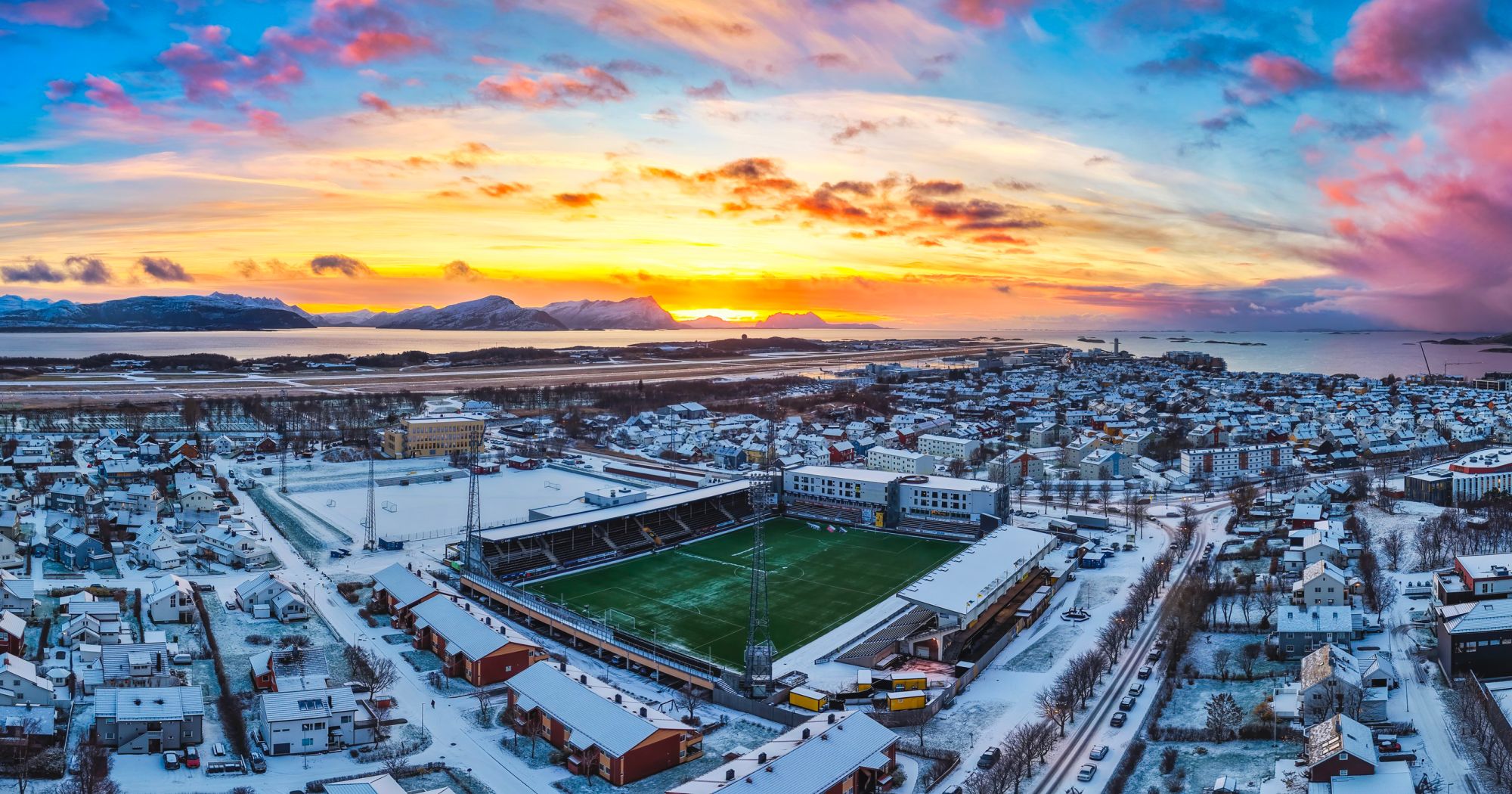
Based in Bodø, a small coastal city in northern Norway just above the Arctic Circle, FK Bodø/Glimt has become one of the most fascinating football stories in modern Europe. Founded on September 16, 1916, the club plays at Aspmyra Stadion, an artificial-turf ground with a capacity of just over 8,000. On paper, it does not look like the home of a continental disruptor. In reality, it has become exactly that.
Bodø/Glimt is no longer simply a romantic underdog from the far north. It is now a club with a clear football identity, a modern tactical model, and a growing reputation for unsettling opponents far bigger, richer, and more established than itself.
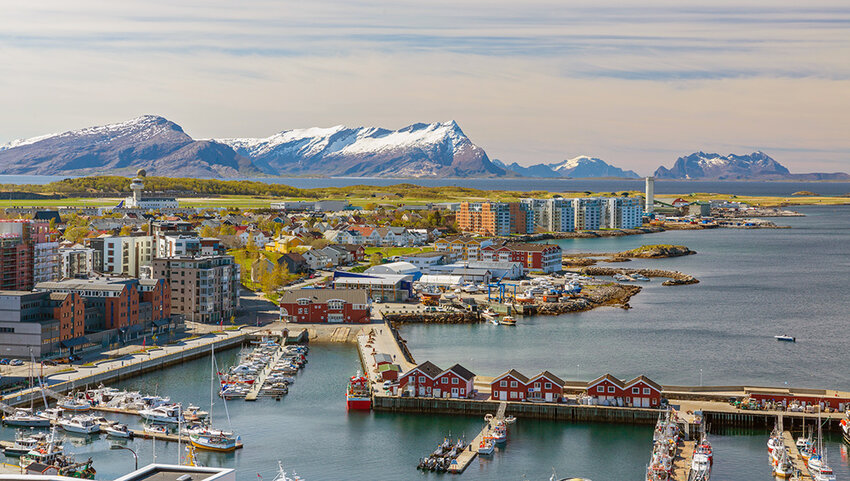
What makes the club so distinctive is that its football cannot be separated from its geography. Bodø is not just another Scandinavian city. It is a place shaped by long winters, biting winds, Arctic light, and a constant closeness to nature. The sea, the mountains, the islands, and the sky all seem to press in around the city. Football in this environment feels different. It looks different. It breathes differently.
That atmosphere is carried directly into Aspmyra. Visiting teams do not simply arrive at another stadium. They step into a setting that feels slightly unfamiliar, slightly harsher, slightly more intense. The artificial pitch, the weather, the rhythm of the place, and the crowd’s sense of identity all combine to create a home environment that is far more powerful than its size might suggest.
And that, in many ways, is the essence of Bodø/Glimt. This is not a club that grew through financial excess or celebrity branding. It grew through continuity, coaching, recruitment, collective discipline, and a deeply rooted sense of who it is. In an age when football often feels consumed by scale, Bodø/Glimt has become a reminder that clarity can still compete with money.
That rise has not happened overnight, even if it may appear sudden from the outside. Domestically, Bodø/Glimt has spent the past several years establishing itself as one of Norway’s defining teams. League titles in 2020, 2021, 2023, and 2024 confirmed that the club’s ascent was no temporary surge. By 2025, even without winning the title, Bodø/Glimt still finished as runners-up with the kind of consistency that marks a genuine top side rather than a fleeting surprise.
This is important, because Bodø/Glimt is often described through the language of shock and disruption. But the truth is more impressive than that. The club did not stumble into success. It built toward it.
That same sense of construction became even more visible in Europe. The 2025–26 UEFA Champions League campaign marked a new level in the club’s development. Bodø/Glimt announced itself in emphatic fashion by crushing Sturm Graz 5–0 at home in the play-offs, securing a first-ever place in the Champions League proper. That alone was historic. What followed made it unforgettable.
In the league phase, Bodø/Glimt did not merely participate. It adapted, endured, and then struck. After a difficult opening stretch, the Norwegian side surged at exactly the right moment, claiming back-to-back wins over Manchester City and Atlético Madrid to force its way into the knockout stage. It was the kind of sequence that turns curiosity into belief.
Then came Inter. By that point, Bodø/Glimt had already become one of the competition’s most intriguing stories, but defeating Inter 5–2 on aggregate gave the run a different weight. It was no longer enough to describe them as brave or spirited. They were tactically mature, structurally coherent, and capable of controlling big moments against elite opposition.
A commanding 3–0 first-leg win over Sporting CP in the Round of 16 only sharpened that impression. European football had seen underdogs before. What it was seeing now was something more durable: a club with a system strong enough to survive the spotlight.

At the center of that system is head coach Kjetil Knutsen, one of the most compelling managerial figures in the modern European game. Knutsen has built Bodø/Glimt around a recognisable 4-3-3 framework, but to reduce his work to formation alone would be to miss the point. His team is not rigid; it is relational. It moves through coordinated spacing, overloads in the half-spaces, intelligent pressing, and fast, prepared transitions.
Bodø/Glimt can dominate possession, but it does not worship the ball. It can press high, but it does not do so recklessly. It can counterattack, but never as a team that merely waits. The intelligence of Knutsen’s approach lies in its balance. The structure is clear, but the application is flexible. Against weaker opposition, Bodø/Glimt can pin teams back through rhythm and circulation. Against stronger sides, it can defend with discipline, absorb pressure, and then attack with devastating speed.
That flexibility is one of the reasons the team feels so modern. Another is its collective emphasis. Patrick Berg, the captain and midfield reference point, is fundamental to the way Bodø/Glimt plays. He controls tempo, positions himself intelligently in build-up, and acts as the stabilizing presence behind the team’s attacking waves. Around him, players such as Jens Petter Hauge, Håkon Evjen, and Kasper Høgh bring penetration, movement, and technical edge. Even the full-backs, Fredrik Bjørkan and Fredrik Sjøvold, are not merely supporting runners on the outside, but active participants in the team’s spatial design.
That is what makes Bodø/Glimt so compelling to watch. Nothing feels random. Attacks are layered. Movements are connected. The team plays with the sense that every player understands not only his role, but also the larger pattern around him.
Yet perhaps the most impressive thing about Knutsen is that his philosophy extends beyond tactics. He has repeatedly framed football through the language of development, learning, and process. Improvement, not noise, sits at the center of his project. In that sense, Bodø/Glimt feels like a club that has trained itself not only to play better, but to think better.
That culture matters. It explains why the team does not look overawed on major European nights. It explains why the club’s progress has survived expectation. And it explains why Bodø/Glimt, despite its size, now carries itself like a side that belongs on this stage.
To understand the club fully, though, one has to return to Bodø itself. This is a city where nature is never far away. Saltstraumen, the world’s strongest tidal current, lies nearby. So do mountain landscapes, Arctic waters, national parks, and the shifting seasonal extremes of the northern lights and the midnight sun. Bodø is small in population, but grand in atmosphere. It feels open, elemental, and sharply defined.
That sense of place matters more than it may first appear. Bodø/Glimt is not simply located in the north. It is shaped by the north. The city’s edge, resilience, and stark beauty all seem to echo in the football the team plays.
And that may be the real reason Bodø/Glimt has captured so much attention across Europe. It is not just because it wins. It is because it feels authentic. In a sport increasingly dominated by scale, sameness, and global polish, Bodø/Glimt offers something rarer: a club whose football still feels inseparable from where it comes from.
What began as a remarkable rise now looks like something more enduring.
Bodø/Glimt is no longer merely a northern curiosity. It is a serious football institution, shaped by Arctic conditions, guided by a clear idea, and carried forward by the belief that collective intelligence can still tilt the game.
From the edge of Norway, it has stepped into the center of Europe’s football conversation.
Kjetil Knutsen and the Bodø/Glimt Blueprint: The Tactical Mind Behind Norway’s Arctic Revolution
In modern football, tactical innovation is often associated with elite clubs, major leagues, and vast resources. Yet one of the most compelling coaching projects in Europe has come not from a superpower, but from the Arctic north of Norway.
At Bodø/Glimt, Kjetil Knutsen has built far more than a successful team. He has built a football identity — one rooted in structure, repetition, intelligence, and collective belief. Under his leadership, Bodø/Glimt has evolved from a domestically ambitious club into one of Europe’s most fascinating tactical case studies.
Knutsen’s work stands out not because it is flashy, but because it is coherent. Everything in his football connects: the build-up, the pressing, the spacing, the transitions, and even the way the team defends after attacking. His side does not simply play with energy. It plays with design.
A Manager Defined by Process
To understand Knutsen’s football, it helps to begin not with shape, but with mindset.
He is not a coach obsessed with results in isolation. His teams are built around process, learning, and constant improvement. That mentality has become one of Bodø/Glimt’s defining strengths. Rather than chasing short-term solutions, Knutsen has developed a squad that trusts repetition, tactical clarity, and collective discipline.
That underlying philosophy explains why Bodø/Glimt often looks so calm in high-pressure games. The team does not appear to improvise under stress. It relies on mechanisms that have been rehearsed, internalised, and sharpened over time.
This is one of Knutsen’s greatest strengths as a coach: he does not merely organise players. He teaches them to inhabit a system.
The Base Structure: 4-3-3 With Functional Flexibility
On paper, Bodø/Glimt is built on a 4-3-3. In reality, the system is far more dynamic.
When the team has possession, the structure expands. The front three are joined by the two advanced midfielders, creating a front line of five in many attacking phases. Behind them, a supporting line provides stability, circulation, and protection against counterattacks. Out of possession, however, the shape often shifts toward a 4-4-2, with one winger pushing up alongside the striker and the midfield narrowing into a compact second line.
This is crucial to understanding Knutsen’s approach. He is not rigidly attached to formation numbers. What matters to him is functional occupation of space. Players are given reference points, but the system is designed to flow according to the phase of play.
That makes Bodø/Glimt tactically flexible without losing its identity. The team can look expansive in possession and compact without it, yet still remain recognisably the same side.
Build-Up Play: Controlled, Layered, and Purposeful
Knutsen’s attacking game begins with structure in the first phase. Bodø/Glimt is not a team that builds slowly for aesthetic reasons. Its build-up is designed to manipulate the opponent.
At the centre of that phase is Patrick Berg, the team’s midfield anchor and tactical metronome. Berg’s role is fundamental. He drops toward the centre-backs when needed, offers angles for progression, and helps the team escape the first wave of pressure. But his importance goes beyond receiving the ball. He dictates tempo, positions himself to support the next pass, and gives the team its balance between ambition and control.
From there, Bodø/Glimt progresses through short, well-timed combinations. The pattern is familiar: centre-back into Berg or the full-back, then into a nearby midfielder or winger, followed by a series of quick combinations on one side of the pitch. The goal is not simply to move forward, but to draw the opposition toward the ball before exploiting the space left elsewhere.
This is why Bodø/Glimt’s build-up often appears patient but never passive. The circulation has intent. Every pass is part of a larger effort to tilt the defensive block and expose its weak side.
Attacking Play: Overloads, Half-Spaces, and Collective Movement
The defining feature of Knutsen’s attacking system is the use of overloads, especially on the flanks and in the half-spaces.
Bodø/Glimt frequently creates local superiority by gathering multiple players on one side of the pitch. A winger, full-back, number eight, and striker may all occupy slightly different vertical lines within the same corridor, forcing defenders into difficult decisions. Who steps out? Who tracks the runner? Who protects the channel?
This is where the team’s movement becomes especially sophisticated.
One common pattern involves one player attacking the channel while another drops into the pocket just behind him. The first movement pulls defenders away; the second exploits the resulting gap. Another recurring mechanism sees the winger hold the width while the full-back moves into an interior support position, allowing Bodø/Glimt to progress not only around the outside, but through the inside lane as well.
That is why this is not a simple wing-based team. It is a team that uses the wing to unlock the half-space, and the half-space to attack the box.
Knutsen’s side is particularly effective at moving from circulation into penetration. Once the block shifts, Bodø/Glimt attacks quickly. The advanced midfielders burst between lines, the striker pins or links, and the far-side winger moves into the box. Within seconds, what looked like a harmless possession phase becomes a five-man attacking structure.
Crossing With Intelligence, Not Habit
Although Bodø/Glimt produces crosses, it is not a crude crossing team. The deliveries usually come after the defence has been manipulated into a narrower shape. Instead of launching hopeful balls into the area, the team often creates better crossing conditions through dribbling, combination play, and positional rotation.
The result is a more controlled final action: lower crosses, sharper cutbacks, and deliveries from closer, more dangerous areas.
This again reflects Knutsen’s broader approach. Attacking is not about volume for its own sake. It is about creating the right moment with the right spacing.
Transitions: Fast, Direct, and Pre-Planned
One of the clearest signs of Bodø/Glimt’s tactical maturity is the quality of its transitions.
The team does not counter merely because the opportunity appears. It counters because the structure behind the recovery is ready. Once possession is won, the first instinct is forward. The next pass looks to break a line. The runner on the outside attacks space immediately. Supporting players move not randomly, but according to pre-established patterns.
That is why Bodø/Glimt’s transitions often feel so sharp. They are not improvised sprints. They are organised accelerations.
Against stronger opponents, this becomes a major weapon. Knutsen’s side can defend in a compact shape, absorb pressure, and then strike with startling directness once the ball is recovered. But even in these moments, the transitions retain their structure. The ball does not simply get cleared into space. It is connected forward with purpose.
Counter-Pressing: The Hidden Core of the System
Perhaps the most underrated aspect of Bodø/Glimt’s football is what happens immediately after it loses the ball.
Knutsen’s team is aggressive in its counter-press. When an attack breaks down, nearby players react instantly, trying to win possession back before the opponent can settle into transition. This is not just about intensity; it is about organisation.
Because the team attacks with a clear structure, it also maintains a clear rest-defence behind the ball. Usually, a line of deeper players remains in place to control second balls and close central spaces, with Berg playing a particularly important role in anticipating the next phase. This gives Bodø/Glimt the confidence to commit bodies forward without losing defensive security.
In practical terms, it means their attacks often come in waves. An opponent may survive the first move, only to find itself immediately trapped by the second.
That ability to sustain pressure is one of the key reasons Bodø/Glimt can dominate phases of play even against stronger teams.
Defensive Structure: Compact, Adjustable, and Intelligent
Out of possession, Knutsen’s side is just as carefully organised.
The defensive shape usually resembles a 4-4-2, with two players screening the first pass and the midfield line compressing the centre. The wide players narrow in to protect interior spaces, forcing the opposition toward less dangerous areas. Importantly, the line does not sink unnecessarily deep. Bodø/Glimt prefers to remain compact and connected, preserving short distances between units.
What makes the defensive model especially effective is its adaptability.
Knutsen does not treat pressing height as a matter of ideology. His team can press higher when the situation invites it, but it can also drop into a mid-block and wait for the right moment to engage. That flexibility allows Bodø/Glimt to remain competitive against different levels of opposition. Against weaker teams, it can suffocate build-up early. Against stronger sides, it can stay compact, deny central progression, and then attack the transition.
This balance is central to Knutsen’s profile as a coach. He is not dogmatic. He is principled, but pragmatic.
Players as Functions Within the System
Like any strong tactical model, Knutsen’s football depends on players understanding their functions, not just their positions.
Patrick Berg is the brain of the side, controlling rhythm and acting as both build-up anchor and defensive stabiliser. Jens Petter Hauge offers width, dribbling, and the ability to destabilise defenders in one-against-one situations. Kasper Høgh gives the front line both finishing presence and link-up capacity, while players such as Håkon Evjen add vertical running and transitional threat.
Even the full-backs are crucial. Fredrik Bjørkan and Fredrik Sjøvold are not simply wide runners. They often step inside, connect phases, and become part of the midfield geometry. This makes Bodø/Glimt’s system harder to predict, because the team’s width and interior presence are created through rotation rather than fixed starting positions alone.
The Knutsen Signature
What, then, defines Kjetil Knutsen as a tactical coach?
It is not one formation, one pressing trigger, or one attacking pattern. It is the way all phases of the game are connected within a shared logic.
His Bodø/Glimt side plays with positional clarity but never stiffness, with intensity but not chaos, with ambition but also control. It can dominate possession, break lines through coordinated movement, defend compactly, and counter with speed. Most importantly, it does all of those things without losing its structural identity.
Knutsen has shown that a club does not need vast resources to become tactically elite. It needs a clear idea, a coach capable of teaching it, and a group willing to commit to it completely.
That is what Bodø/Glimt has become under his leadership: not simply a successful team from Norway, but one of the most intelligently coached sides in European football.

 VIKING BARCA