
Scientific and Technical Analysis of Lamine Yamal’s Football Strengths
Lamine Yamal, a prodigious talent for FC Barcelona and the Spanish national team, exhibits remarkable strengths on the pitch. These strengths can be analyzed scientifically and technically across various aspects of his game:
1. Dribbling Ability and Agility
- Low Center of Gravity: Yamal’s relatively short stature and light frame provide him with a low center of gravity. This allows for greater balance and stability during quick direction changes, making him a highly effective dribbler.
- Scientific Basis: A lower center of gravity reduces the torque required for directional changes, enhancing his ability to evade defenders. This also minimizes energy expenditure during repeated movements.
- Quick Reaction Time: Yamal’s ability to process visual information and react swiftly to on-field situations sets him apart.
- Neuroscientific Basis: His reaction speed stems from efficient neural processing between the visual cortex and motor areas, allowing precise and immediate responses in high-pressure scenarios.
2. Technical Skills
- Exceptional Ball Control: His fine motor skills enable him to manipulate the ball with precision, even in tight spaces.
- Biomechanical Analysis: His precise control can be attributed to efficient neuromuscular coordination, particularly in the lower limbs, and a high level of proprioception.
- One-on-One Duels: Yamal’s feints and body movements often unbalance opponents.
- Kinematic Advantage: His quick shifts in weight and deceptive body orientation disrupt defenders’ anticipation and timing, creating space for attacks.
3. Speed and Acceleration
- Explosive First Step: Yamal can generate rapid acceleration over short distances, giving him a significant edge in sprints.
- Physiological Basis: This is likely due to a high proportion of Type II muscle fibers, which are specialized for explosive power.
- Sustained Top Speed: Yamal can maintain high speeds over longer distances, making him a constant threat on the wings.
- Aerobic Efficiency: His cardiovascular system appears to support efficient oxygen delivery, enhancing his endurance during high-intensity plays.
4. Vision and Game Intelligence
- Peripheral Vision: Yamal demonstrates exceptional spatial awareness, identifying teammates and opponents even in crowded areas.
- Neuroscientific Basis: His ability to process peripheral visual cues and integrate them into his decision-making suggests strong visual-cognitive skills.
- Anticipation Skills: He predicts opponents’ movements and adjusts his actions accordingly.
- Cognitive Science: This is rooted in pattern recognition and the ability to recall and apply learned scenarios during gameplay.
5. Mental Toughness and Focus
- Composure Under Pressure: Despite his young age, Yamal remains calm and composed in high-pressure situations.
- Psychological Basis: This can be linked to low cortisol responses under stress, enabling clear decision-making in critical moments.
- Sustained Focus: He consistently stays engaged throughout the game, minimizing errors.
- Neuroscientific Basis: High activity in the prefrontal cortex likely supports his ability to maintain attention over extended periods.
6. Physical Stamina and Potential for Growth
- Endurance and Recovery: Yamal’s ability to maintain high performance throughout the game indicates excellent stamina.
- Physiological Analysis: Balanced aerobic and anaerobic systems support his ability to perform repeated sprints and recover quickly during matches.
- Growth Potential: As a young player, Yamal’s physical attributes (e.g., muscle mass, strength) are still developing. With proper training, his physical performance could reach even higher levels.
- Predictive Modeling: Continued development in muscle hypertrophy and neuromuscular efficiency could make him more dominant in physical duels and sustained performances.
Conclusion:
Lamine Yamal’s strengths are deeply rooted in his biomechanical efficiency, neuromuscular coordination, and cognitive processing capabilities. His low center of gravity, explosive speed, and technical finesse make him a formidable dribbler, while his vision and game intelligence allow him to make impactful decisions. With further physical and tactical development, Yamal has the potential to become one of the world’s leading football players.
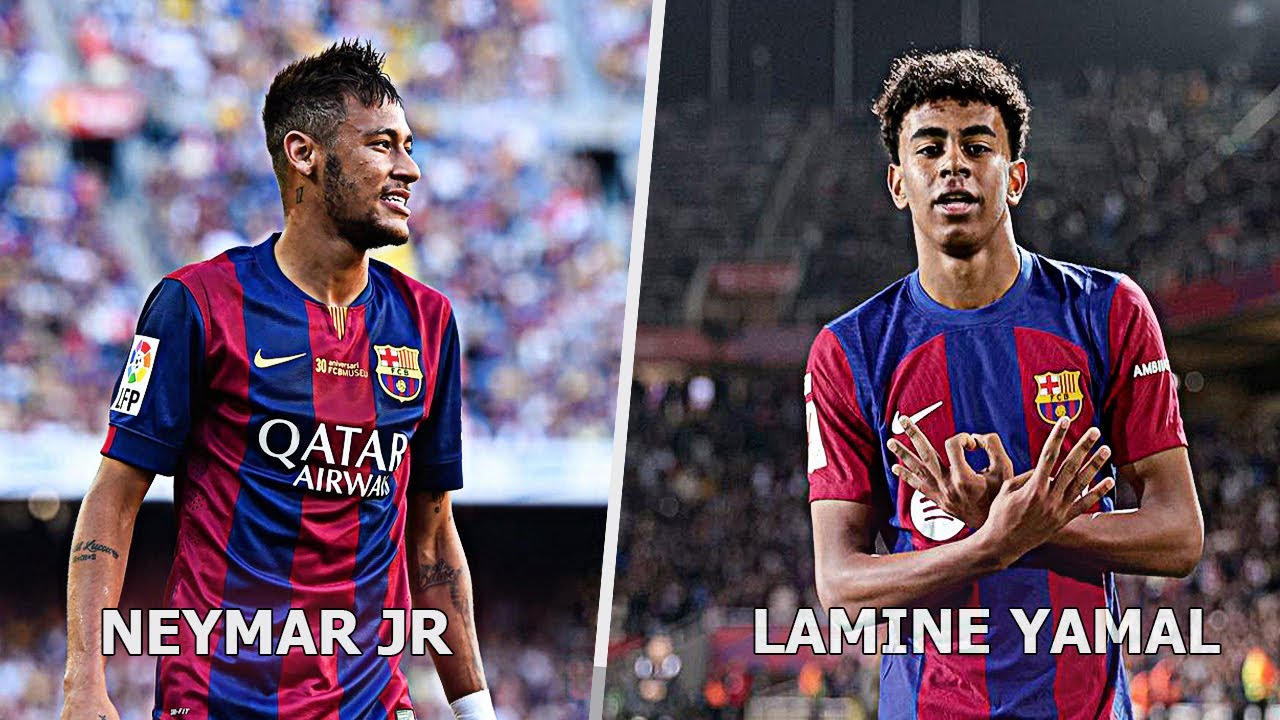
Comparative Analysis: Lamine Yamal vs. Neymar’s Dribbling Rhythm and Style from an Athletic Perspective
Lamine Yamal and Neymar share a creative and unpredictable dribbling style that dazzles defenders and captivates audiences. However, there are key differences in their techniques, rhythm, and athletic execution. Let’s analyze their dribbling styles from an athletic and biomechanical perspective:
1. Dribbling Rhythm
- Neymar’s Rhythm:
- Neymar’s dribbling style is characterized by frequent pauses, quick bursts of acceleration, and sudden deceleration. He uses a “stop-and-go” rhythm to manipulate defenders, forcing them to react to his hesitations.
- Neymar often integrates body feints and subtle lateral movements to create space, with a cadence that keeps opponents guessing.
- Biomechanical Insight: Neymar’s rhythm relies heavily on his ability to control momentum through rapid weight shifts and efficient hip rotation. His ability to decelerate quickly minimizes reaction time for defenders.
- Yamal’s Rhythm:
- Lamine Yamal adopts a smoother, more continuous dribbling rhythm. While he does use variations in pace, his transitions between movements are more fluid compared to Neymar’s sharper hesitations.
- His style focuses on accelerating past defenders with seamless ball control, relying on a steady tempo punctuated by occasional bursts.
- Biomechanical Insight: Yamal’s rhythm emphasizes efficient linear acceleration, with a lower reliance on pauses and feints. His dribbling appears more natural and instinctive, leveraging his smaller stature for tight control in confined spaces.
2. Dribbling Style
- Neymar’s Style:
- Neymar is known for his flamboyant dribbling that combines tricks, stepovers, and roulettes with frequent use of the outside and sole of the foot.
- He employs an artistic, improvisational style, often engaging defenders in 1v1 situations to humiliate and bypass them.
- Neymar frequently changes direction at extreme angles, leveraging his exceptional flexibility and core strength.
- Athletic View: Neymar’s style depends on high levels of hip mobility, ankle dexterity, and eccentric muscle control. His feints involve exaggerated limb movements that make defenders overcommit.
- Yamal’s Style:
- Yamal’s dribbling is more direct and efficient compared to Neymar’s. While he does employ body feints, he avoids unnecessary flair, focusing on maximizing speed and control.
- He utilizes small, precise touches with the instep and inside of the foot, maintaining close proximity to the ball while weaving through defenders.
- His style is better suited for quick positional play and exploiting tight spaces, particularly in high-pressure scenarios.
- Athletic View: Yamal’s dribbling style depends on agility and fast-twitch muscle activation, enabling rapid direction changes and short bursts of speed without losing balance.
3. Use of the Body
- Neymar:
- Neymar’s dribbling involves exaggerated upper-body movements, such as shoulder drops and lateral sways, to confuse opponents. These movements complement his technical footwork, creating a multi-dimensional deception.
- His ability to absorb physical contact is another hallmark, using his core strength and balance to stay on his feet despite aggressive challenges.
- Biomechanical Analysis: Neymar’s upper-body feints rely on strong rotational torque from his thoracic spine and rapid activation of stabilizing muscles.
- Yamal:
- Yamal’s body usage is more subtle and functional. Instead of exaggerated feints, he relies on lower-body precision and rapid weight shifts to unbalance defenders.
- He avoids over-relying on physicality, focusing on his agility to evade rather than resist contact.
- Biomechanical Analysis: Yamal’s compact frame gives him a low center of gravity, allowing him to pivot and shift directions with minimal inertia.
4. Athletic Differences
| Aspect | Neymar | Lamine Yamal |
|---|---|---|
| Explosiveness | Neymar excels in short, sharp accelerations and changes of pace. | Yamal has more linear acceleration, with smoother speed transitions. |
| Balance | Neymar’s core strength helps him resist physical challenges. | Yamal uses agility to avoid physical confrontations altogether. |
| Creativity | Neymar thrives on flair and improvisation. | Yamal focuses on efficiency and precision. |
| Footwork | Neymar employs tricks like stepovers, roulettes, and nutmegs. | Yamal prefers tight touches and quick direction changes. |
5. Key Similarities
- Deceptive Movements: Both players are highly deceptive, able to exploit a defender’s misstep or hesitation effectively.
- Defender Engagement: They both invite challenges from defenders, using dribbling to create space and destabilize the opposition.
- Ball Control: Both exhibit elite close control, keeping the ball within inches of their feet even at high speeds.
Conclusion
While Neymar and Yamal share some stylistic similarities, their approaches differ in rhythm and execution. Neymar’s dribbling style is flamboyant and designed to entertain, using exaggerated feints and frequent pauses. In contrast, Yamal’s style is direct, fluid, and efficiency-driven, making it highly effective in modern high-paced football.
From an athletic perspective, Neymar’s style relies more on flair, eccentric muscle control, and physical resistance, while Yamal’s approach emphasizes agility, balance, and rapid acceleration. These differences reflect their unique roles and developmental stages, with Neymar’s artistry contrasting Yamal’s more streamlined and pragmatic approach.

 VIKING BARCA