

The Evolution of Human Running Ability Proved by the Sub-Two-Hour Marathon
How biomechanics, training science, East African highland physiology, and racing technology are redefining the limits of endurance sport
For decades, the sub-two-hour marathon stood as one of the most symbolic barriers in human endurance sport. To complete 42.195 kilometers in under two hours requires an average pace of roughly 2 minutes and 50 seconds per kilometer — the equivalent of running each 100 meters in about 17 seconds, repeated more than 421 times.
This is not simply a matter of “running for a long time.” It represents the extreme integration of cardiovascular capacity, muscular efficiency, neuromuscular control, biomechanics, training science, nutrition, footwear technology, pacing strategy, and psychological discipline.
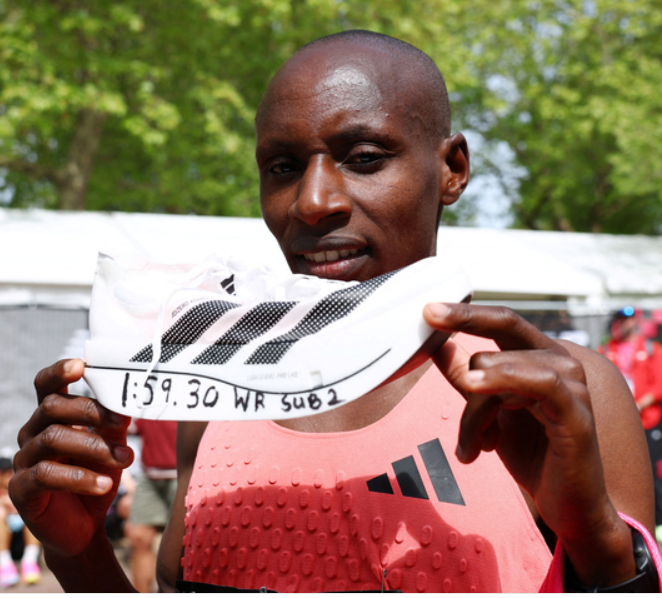
At the 2026 London Marathon, Kenya’s Sabastian Sawe ran 1:59:30, while Ethiopia’s Yomif Kejelcha finished second in 1:59:41, according to World Athletics’ official competition results. (worldathletics.org) The London result marked the first time athletes had run under two hours in a record-eligible competitive marathon, although formal world-record recognition still depends on the standard ratification process. Reuters also reported that Sawe’s historic performance was closely linked to the latest generation of Adidas racing-shoe technology. (Reuters)
Yet the significance of the sub-two-hour marathon is larger than one race. It does not prove that the human body suddenly became superhuman. It proves something more complex: human running limits are not fixed walls, but moving boundaries shaped by physiology, biomechanics, training culture, technology, and environment.
1. The Core Meaning of the Sub-Two-Hour Marathon: Not a Bigger Engine, but a More Efficient System
For many years, endurance performance was often explained through the idea of a large aerobic “engine.” In other words, the athlete with the highest oxygen uptake was assumed to have the greatest advantage. But modern marathon performance cannot be explained by VO₂max alone.
At the elite level, most world-class marathoners already possess extraordinary aerobic capacity. The decisive difference increasingly comes from running economy — how little energy an athlete uses at a given speed.
Table 1. Key Performance Factors in the Marathon
| Factor | Meaning | Relationship to Marathon Performance |
|---|---|---|
| VO₂max | The body’s ability to use oxygen at maximum effort | The basic aerobic engine |
| Lactate Threshold | The ability to sustain fast speeds before fatigue rises sharply | Determines how long high speed can be maintained |
| Running Economy | The energy cost of running at a given pace | The key factor in record-breaking performance |
A sub-two-hour marathon is not produced simply by a strong heart or large lungs. It is produced by an athlete who minimizes wasted motion, converts ground reaction force into forward propulsion, and maintains technical efficiency even in the final stages of fatigue.
From a biomechanics perspective, the best marathoners do not “jump” their way through the race. They reduce vertical oscillation, land close to the body’s center of mass, limit braking forces, and use the ankle–Achilles tendon complex like a spring. Each step stores elastic energy during landing and reuses part of that energy during toe-off.
In this sense, the sub-two-hour marathon is a victory of efficiency. The body becomes a refined movement system: light, elastic, stable, and resistant to mechanical breakdown.
2. The Progression of the Men’s Marathon Record: The Era of Less Waste
The history of the men’s marathon record shows that performance improvement has not been only about stronger athletes. It has also been about reducing energy loss.
Table 2. Major Stages in the Men’s Marathon Record Progression
| Period / Athlete | Record | Historical Meaning |
|---|---|---|
| 2003 — Paul Tergat | 2:04:55 | Broke the 2:05 barrier |
| 2008 — Haile Gebrselassie | 2:03:59 | Entered the 2:03 range |
| 2014 — Dennis Kimetto | 2:02:57 | Broke the 2:03 barrier |
| 2018 — Eliud Kipchoge | 2:01:39 | Made the two-hour barrier feel realistic |
| 2023 — Kelvin Kiptum | 2:00:35 | Came within 36 seconds of sub-two |
| 2026 — Sabastian Sawe | 1:59:30 | First competitive marathon under two hours |
Kelvin Kiptum’s 2:00:35 at the 2023 Chicago Marathon was ratified by World Athletics and made him the first athlete to break 2:01 in a record-eligible marathon. (Runner’s World) Sawe’s 2026 London performance then pushed the event into an entirely new symbolic era.
However, this history must also distinguish between official competition and controlled experimental attempts. In 2019, Eliud Kipchoge ran 1:59:40.2 in the INEOS 1:59 Challenge in Vienna. That performance proved that the human body could cover the marathon distance in under two hours, but it was not eligible as a world record because of rotating pacemakers and non-standard race conditions.
Therefore, the sub-two-hour marathon evolved in two stages. Kipchoge showed that sub-two was biologically possible. Sawe showed that it could be achieved in competitive marathon racing.
3. East African Highland Runners: The Biomechanical and Environmental Advantage
No analysis of modern marathon dominance is complete without examining runners from Kenya, Ethiopia, and Uganda. Their success should not be reduced to simplistic claims of racial superiority. A more accurate explanation is that multiple factors overlap: altitude, body morphology, childhood activity patterns, training culture, competition density, and economic motivation.
Many elite East African distance runners come from highland regions such as Kenya’s Rift Valley or Ethiopia’s altitude training areas. These environments expose athletes to lower oxygen pressure, which may support long-term endurance adaptations. But altitude alone does not create champions. The advantage appears when altitude is combined with favorable body structure, efficient movement mechanics, and a highly competitive training ecosystem.
Table 3. Physical Characteristics Often Observed in Elite East African Distance Runners
| Characteristic | Biomechanical Advantage |
|---|---|
| Low body mass | Reduces impact forces and total energy cost |
| Low body-fat percentage | Improves heat dissipation and endurance efficiency |
| Long lower-limb proportion | Supports efficient stride mechanics |
| Slim calves and light lower legs | Reduces rotational inertia during leg swing |
| Elastic ankle–Achilles tendon complex | Helps recycle landing energy into propulsion |
| Highland upbringing | May support oxygen-use adaptation |
The mass of the lower leg is especially important in distance running. During a marathon, the legs swing forward and backward tens of thousands of times. A heavy lower leg increases the energy required for each stride. A lighter calf and ankle region reduce rotational inertia, making it easier to maintain stride rhythm over long distances.
This is why East African marathon excellence is best understood as an integrated system. These athletes often combine light frames, efficient lower-limb mechanics, high aerobic development, and years of group-based endurance training.
4. Altitude Adaptation: How Oxygen Stress Shapes Endurance Capacity
Highland regions such as Iten and Eldoret in Kenya, and several Ethiopian training centers, have become global hubs of distance running. At altitude, the oxygen pressure is lower than at sea level. Over time, this environment can encourage the body to become more efficient at transporting and using oxygen.
Table 4. Altitude-Related Adaptations and Their Marathon Effects
| Adaptation | Marathon Effect |
|---|---|
| Improved oxygen transport | Helps sustain high-speed running for long periods |
| Increased capillary development | Improves oxygen delivery to working muscles |
| Enhanced mitochondrial function | Supports efficient aerobic energy production |
| Improved fat oxidation | Delays energy depletion in the later stages |
| Better thermoregulation | Helps control body temperature during long races |
Still, it is important not to overstate altitude as a single cause. Many people live at altitude without becoming elite athletes. The key is the combination of altitude exposure, lean body morphology, early-life physical activity, elite training groups, and international competition experience.
In other words, East African dominance is not the result of one magic factor. It is the result of an entire endurance-performance ecosystem.
5. Training Science: From Running More to Adapting Better
Modern marathon training has moved beyond the old idea that success comes only from running more mileage. High volume still matters, but elite preparation is now far more precise. Coaches and athletes structure training around specific physiological and biomechanical adaptations.
Table 5. Major Components of Modern Elite Marathon Training
| Training Method | Primary Purpose |
|---|---|
| Easy Runs | Recovery and aerobic foundation |
| Long Runs | Muscular endurance and fat metabolism |
| Tempo Runs | Lactate-threshold development |
| Interval Training | VO₂max and high-speed endurance |
| Hill Training | Propulsive strength, ankle stiffness, and postural control |
| Marathon-Pace Runs | Neuromuscular adaptation to target race speed |
The most important modern development may be fatigue resistance. Earlier marathon strategies often focused on surviving the final 10 kilometers. Today’s world-record-level runners are expected to maintain or even increase pace in the final stages.
This is not just a matter of mental toughness. Late-race performance depends on whether the athlete can preserve hip stability, stride length, cadence, posture, foot stiffness, and ground-contact efficiency under extreme fatigue. Sawe’s London performance included a powerful negative split, with the second half faster than the first, according to the London Marathon’s own race report. (London Marathon Events)
The modern marathoner is therefore trained not only to run fast, but to remain mechanically efficient when exhausted.
6. Supershoes: Technological Doping or the Evolution of the Sport?
The recent acceleration of marathon records cannot be separated from the rise of carbon-plated supershoes. These shoes combine ultra-light foam, stiff plates, and rocker-shaped geometry to reduce energy loss at the foot and ankle.
Reuters reported that Sawe wore Adidas’ latest Adizero Adios Pro Evo 3, a 97-gram racing shoe that Adidas said improved running economy by 1.6 percent compared with its predecessor. (Reuters) This has revived debate over whether supershoes represent technological progress or an unfair form of performance enhancement.
The most balanced view is that supershoes do not replace human ability. They amplify it. Their benefits are greatest for athletes who already possess efficient mechanics, strong aerobic capacity, stable foot strike patterns, and the muscular durability to maintain high speed for two hours.
The shoes help in three main ways:
| Supershoe Feature | Performance Effect |
|---|---|
| High-rebound foam | Reduces energy lost at landing |
| Carbon or stiff plate structure | Improves forward rolling mechanics |
| Lightweight construction | Reduces energetic cost over long distance |
In the marathon, tiny savings become enormous. If a shoe reduces energy cost slightly at each stride, the cumulative effect over more than 40 kilometers can be decisive.
7. Women’s Marathon Development: A Frontier with Greater Remaining Potential
The women’s marathon is also progressing rapidly. Ruth Chepngetich ran 2:09:56 at the 2024 Chicago Marathon, becoming the first woman to break 2:10. World Athletics reported that the performance improved Tigst Assefa’s previous world record of 2:11:53 by nearly two minutes. (Runner’s World)
However, women’s marathon records must be interpreted carefully because World Athletics distinguishes between mixed-gender races and women-only races. Mixed races can involve male pacemakers, drafting effects, and different rhythm conditions. Women-only races provide a separate standard for performances achieved without male pacing assistance.
At the 2026 London Marathon, Tigst Assefa ran 2:15:41, setting a new women-only world record and improving her own previous mark by nine seconds. Reuters also reported that Hellen Obiri and Joyciline Jepkosgei finished close behind, making it the first women’s race in which three athletes broke 2:16. (Reuters)
Table 6. Key Reference Points in Women’s Marathon Progression
| Athlete / Context | Record | Meaning |
|---|---|---|
| Paula Radcliffe | 2:15:25 | Long-standing benchmark of women’s marathon excellence |
| Brigid Kosgei | 2:14:04 | Major breakthrough in the supershoe era |
| Tigst Assefa | 2:11:53 | Shifted the women’s marathon toward the 2:10 range |
| Ruth Chepngetich | 2:09:56 | First woman under 2:10 |
| Tigst Assefa, women-only race | 2:15:41 | New women-only world record at 2026 London |
The women’s marathon may still have broader room for development than the men’s event. The men’s record has now crossed the symbolic two-hour boundary and is moving into extremely narrow physiological margins. The women’s event, by contrast, is still benefiting from expanding elite depth, improved pacing, more advanced fuelling, greater shoe access, and the continued rise of East African highland athletes.
A realistic next frontier for the women’s mixed marathon is the 2:08 range. For women-only racing, the next likely targets are 2:14 and eventually 2:13 under ideal conditions.
8. What the Sub-Two-Hour Marathon Really Proves
The sub-two-hour marathon does not mean that human limits have disappeared. It shows that those limits are complex, layered, and constantly being reshaped.
The performance is the product of four major developments:
Table 7. Four Forces Behind the Sub-Two-Hour Marathon
| Development Area | Contribution to Performance |
|---|---|
| Highland environment and endurance culture | Builds long-term aerobic capacity |
| Lean morphology and efficient lower-limb mechanics | Reduces energy cost and improves running economy |
| Advanced training science | Improves lactate threshold, fatigue resistance, and late-race speed |
| Supershoes, fuelling, pacing, and course selection | Optimizes the race environment and reduces energy leakage |
The modern marathoner is not simply an endurance athlete. He or she is the product of a complete performance system: altitude-born aerobic development, efficient biomechanics, high-volume but targeted training, advanced recovery, precise carbohydrate intake, competitive group culture, and footwear designed to preserve energy.
East African highland athletes sit at the center of this transformation. They are not merely talented individuals. They represent one of the most refined models of modern endurance performance: an interaction of environment, body structure, training culture, and competitive opportunity.
The sub-two-hour marathon proves one essential point:
The limit of human running is not a fixed wall.
It is a moving boundary pushed forward by science, training, environment, technology, and the rare athlete capable of bringing them all together.


