
Records and Intelligence Combined: How Lionel Messi Is Proving He Is Still the Greatest Player in Football History
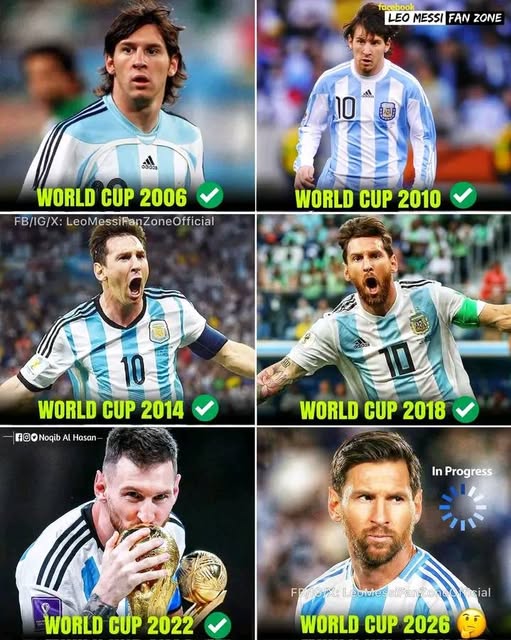
Lionel Messi’s 2026 FIFA World Cup is not simply another chapter of record-breaking. It is a sports science case study showing how an elite athlete can continue to evolve even after passing the usual physical peak of a footballer. Messi first appeared on the World Cup stage as a teenage prodigy in 2006. Twenty years later, at the 2026 World Cup, he is not merely extending his career. He is still deciding matches, controlling the rhythm of games, and redefining what football intelligence can look like at the highest level.
In Argentina’s first two group-stage matches of the 2026 World Cup, Messi delivered performances that were both historic and scientifically fascinating. Against Algeria, he scored a hat trick in a 3-0 victory. Against Austria, he missed an early penalty but recovered mentally and scored twice in a 2-0 win. Argentina’s first five goals of the tournament all came from Messi. With those goals, he reached 18 World Cup goals, surpassing Miroslav Klose’s record and becoming the all-time leading scorer in men’s World Cup history.
At the same time, Messi added several other major records: six World Cup appearances, 28 World Cup matches, the oldest hat trick in World Cup history, and a run of six consecutive World Cup matches with a goal. These are not just statistical achievements. They show that Messi’s greatness is built on a rare combination of technical ability, tactical intelligence, mental control, longevity, and adaptation.
1. Messi’s Major World Cup Records
| Category | Messi’s Record | Sporting Meaning |
|---|---|---|
| World Cup appearances | 6 tournaments | 2006, 2010, 2014, 2018, 2022, and 2026. This shows extraordinary longevity at the highest level. |
| World Cup matches played | 28 matches | One of the greatest appearance records in World Cup history, especially because Messi has usually played as a key player, not just a squad member. |
| World Cup goals | 18 goals | He surpassed Miroslav Klose’s 16-goal record and became the all-time leading World Cup scorer. |
| World Cup assists | 8 assists | This places him among the greatest creators in World Cup history, alongside Diego Maradona. |
| Total World Cup goal contributions | 26 | 18 goals and 8 assists. This proves that Messi is both a scorer and a playmaker. |
| Goals in the first two matches of 2026 | 5 goals | A hat trick against Algeria and two goals against Austria show that he remains highly productive even in his late thirties. |
| Oldest World Cup hat trick | 38 years and 357 days | A remarkable example of elite performance beyond the normal physical peak of a footballer. |
| Consecutive World Cup matches scored in | 6 matches | This shows consistent scoring ability, not just one outstanding performance. |
| World Cup Golden Balls | 2 | He won the award in 2014 and 2022, proving that his influence goes beyond goals alone. |
What makes these records extraordinary is not only their scale. Messi’s World Cup legacy combines scoring, assisting, game control, leadership, and longevity. Very few players in football history have shown both Golden Boot-level production and elite playmaking ability across such a long period.
2. Comparing Messi in His Twenties and Thirties
Messi’s World Cup career shows a fascinating transformation. In general, footballers reach their physical peak in their twenties. Speed, acceleration, repeated sprint ability, and explosive dribbling usually decline with age. However, Messi’s World Cup scoring output has actually become stronger in his thirties.
| Category | Messi in His Teens and Twenties | Messi in His Thirties |
|---|---|---|
| World Cup period | 2006, 2010, 2014 | 2018, 2022, 2026 first two matches |
| Age range | 18 to 27 | 31 to 38 |
| Matches played | 15 matches | 13 matches |
| Goals | 5 goals | 13 goals |
| Assists | Around 2 assists | Around 6 assists, depending on the statistical source |
| Main image | Explosive dribbler and creative attacker | Game controller, scorer, leader, and complete finisher |
| Style of play | Direct dribbling, acceleration, and individual creation | Spatial control, scanning, one-touch finishing, and tempo management |
| Main strengths | Acceleration, close control, direction change, dribbling, creative passing | Vision, scanning, positioning, shooting efficiency, emotional control, and game management |
| Team role | Main attacking star within the team structure | Tactical center, psychological leader, and decisive match-winner |
| Major achievement | 2014 World Cup finalist and Golden Ball winner | 2022 World Cup winner, Golden Ball winner, and 2026 all-time World Cup scoring record |
The most important point in this comparison is that Messi’s scoring output has increased in his thirties. In his twenties, Messi was already the world’s best dribbler and creator. But in terms of World Cup scoring efficiency, his later career has become even more productive. This does not mean he has become physically younger. It means he has redesigned his game to match his changing body.
3. Messi’s Evolution from a Sports Science Perspective
From a sports science perspective, football performance is not determined only by running speed. In a complex sport like football, performance depends on physical qualities, technical skill, decision-making, spatial awareness, emotional regulation, and fatigue management. Messi remains elite because these elements are integrated at an exceptionally high level.
First, Messi’s cognitive speed is outstanding. As players age, pure speed and repeated sprint ability often decline. However, Messi’s greatest strength is not simply reacting quickly after receiving the ball. His strength lies in reading the game before the ball reaches him. He scans his surroundings, identifies defensive gaps, checks the goalkeeper’s position, and anticipates his teammates’ movements. This allows him to make faster and more accurate decisions under pressure.
Second, Messi has exceptional movement economy. In his younger years, he often destroyed defenders through long dribbles and sudden acceleration. In 2026, he does not sprint constantly. Instead, he moves at the right moment and appears in the most dangerous spaces. From a sports science point of view, this is an extremely efficient way to play. He reduces unnecessary physical effort and saves energy for decisive actions.
Third, Messi’s motor control remains at an elite level. His goals against Algeria and Austria were not simply the result of power. They required balance, body orientation, ankle control, timing, visual focus, and precise technical execution. As athletes age, some physical qualities may decline, but highly trained technical patterns can remain extremely stable. Messi’s finishing is not based only on strength. It is based on body angle, ball position, defensive pressure, and goalkeeper movement.
Fourth, Messi’s psychological resilience was clearly shown against Austria. After missing an early penalty, he did not disappear from the game. Instead, he regained control, scored twice, and led Argentina to victory. This is not just a matter of confidence. It is a form of elite self-regulation. The ability to recover concentration, breathing, decision-making, and technical execution after a major mistake is one of the most important qualities of an elite athlete.
4. The Algeria Match: Prediction, Positioning, and Finishing
Messi’s hat trick against Algeria showed the full range of his evolved game. His first goal came from a precise shot near the edge of the box. It was not just a powerful strike. It was a shot placed into an area where the goalkeeper had little chance to react.
His second goal came from anticipation. Messi reacted to a rebound and finished from close range. This goal revealed one of the most important qualities of his late-career game: he does not need to run the most. He needs to know where the ball will arrive before everyone else.
His third goal combined movement, passing, and finishing. He linked play, moved into space, received the ball again, and finished with his left foot. This showed that Messi is not only a final shooter. He is also the player who can help create the situation before completing it.
Scientifically, these goals involved situational awareness, reaction time, balance, technical control, and decision-making. The Algeria match proved that Messi’s current greatness is not based only on old habits or experience. It is the result of a refined and highly efficient football brain.
5. The Austria Match: Game Management and Emotional Control
The Austria match showed another side of Messi’s greatness. Missing a penalty early in the match could have damaged his confidence. Many players become rushed or emotionally unstable after such a mistake. Messi did the opposite. He stayed within the rhythm of the game, continued to find dangerous spaces, and scored twice.
This match was especially important because it showed Messi’s game management ability. Even when he is not constantly touching the ball, the opponent must always adjust to his position. When Messi moves between the center and the right half-space, defenders narrow their shape. That creates space for Argentina’s other attackers. In other words, Messi influences the game even without the ball.
This is a higher level of football intelligence than individual skill alone. Messi’s development does not mean he has become faster. It means he processes more information, moves more efficiently, and chooses better moments to act. That is the true evolution of Messi in his late thirties.
6. Why Messi’s Football Is Still Developing
Messi’s development is not a physical transformation. It is a tactical and cognitive transformation. In his younger years, he controlled matches by carrying the ball and beating defenders directly. Now, he controls matches by reading structures, finding weak points, and using fewer touches more effectively.
This is closely related to experience-based anticipation. Experienced elite players do not simply remember more situations. They recognize patterns faster. Messi has accumulated nearly two decades of World Cup and top-level club experience. This allows him to see the next space before defenders move and to choose a shooting angle before the goalkeeper reacts.
Messi’s individual ability is also deeply connected to team operation. He is both a scorer and a playmaker. He can be the starting point of an attack and the final finisher. When he drops deeper, Argentina can control the tempo. When he moves closer to the box, Argentina becomes more dangerous in front of goal. Very few players can control a team’s rhythm, direction, emotional stability, and finishing at the same time.
7. Conclusion: Messi and the Conditions of the Greatest Player in History
The Messi of 2026 is no longer the same player as the Messi of his twenties. However, he may be a more complete version of himself. In his twenties, he destroyed opponents with acceleration, dribbling, and genius. In his thirties, he controls matches through experience, anticipation, positioning, and emotional stability.
His World Cup records — 18 goals, 8 assists, six tournament appearances, 28 matches, the oldest World Cup hat trick, and six consecutive World Cup matches with a goal — are more than numbers. They are evidence that Messi has maintained world-class performance beyond the usual physical peak of a footballer.
From a sports science point of view, Messi’s greatness cannot be explained simply by saying that he has “defied age.” More accurately, he has adapted to age. He runs less, but moves more intelligently. He waits longer, but finishes more decisively. He may not be faster than before, but he reads the game earlier than everyone else.
That is why the 2026 World Cup does more than add new records to Messi’s career. It proves again that he has the complete profile of the greatest footballer in history: individual skill, tactical intelligence, decision-making, creativity, leadership, emotional resilience, longevity, and the ability to evolve. Messi’s football has not become old. It has become more precise.


