From Tiki-Taka to Vertical Control: How Spain Reinvented Its Footballing Identity
Comparing the Euro 2008–World Cup 2010–Euro 2012 Dynasty with Spain’s Euro 2024 and 2026 World Cup Champions
Spain’s two great championship eras were built on the same footballing foundation, yet they expressed that foundation in markedly different ways.
The team that won Euro 2008, the 2010 FIFA World Cup and Euro 2012 became the defining international side of its generation. Its dominance was based on positional superiority, numerical overloads in midfield and almost total control of possession. Spain did not simply defeat opponents; it deprived them of the ball, territory and emotional momentum.
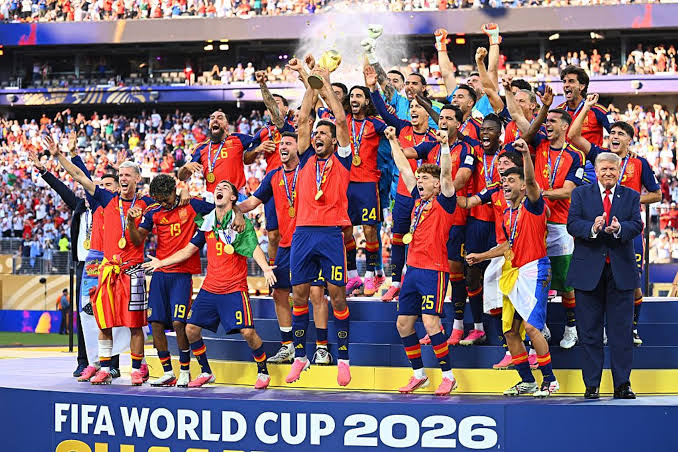
The Spain side that won Euro 2024 and the 2026 World Cup represented an evolution rather than a rejection of that tradition. Luis de la Fuente’s team retained the technical principles associated with Spanish football and FC Barcelona, but added greater verticality, wider attacking structures, aggressive pressing and more direct transitional threat.
The earlier Spain controlled matches through the centre. The modern Spain controls matches across the entire width of the pitch.
That difference explains how Spanish football moved from the age of Xavi, Andrés Iniesta and Sergio Busquets to the era of Lamine Yamal, Pedri and Gavi.
Two Golden Generations, Two Different Expressions of Control
The first Spanish dynasty emerged under Luis Aragonés at Euro 2008 and reached its tactical peak under Vicente del Bosque between 2010 and 2012.
Aragonés made the decisive structural change. He moved Spain away from a more traditional direct game and placed technically gifted midfielders at the centre of the national team. Instead of relying primarily on physical duels, crosses or individual attacking moments, Spain would dominate through short passing, intelligent positioning and collective movement.
Del Bosque inherited that framework and made it even more controlled. His Spain side became extraordinarily difficult to press because almost every player could receive under pressure, play in tight spaces and maintain the team’s positional structure.
Luis de la Fuente’s Spain is different. It still values the ball, but possession is no longer treated as the final objective. The ball is used to create advantageous situations, accelerate attacks and isolate dangerous players in one-versus-one positions.
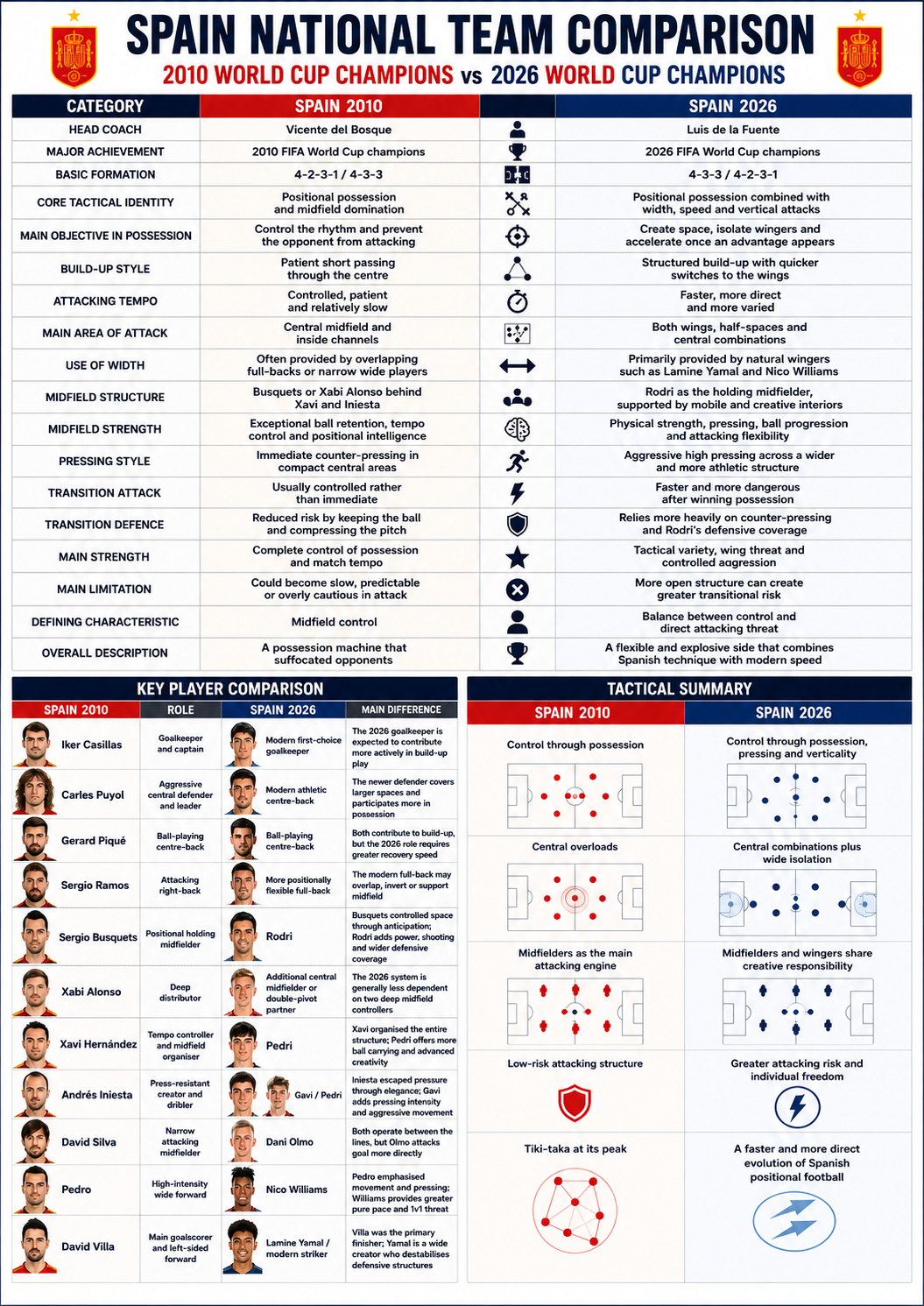
The contrast can be summarised simply:
The 2008–2012 generation used possession to prevent the opponent from playing.
The 2024–2026 generation uses possession to create the conditions for attacking more aggressively.
The Tactical Architecture of the 2008–2012 Dynasty
Spain’s classic championship side was built around midfield superiority.
The nominal formation was often a 4-3-3 or 4-2-3-1, but the structure was highly fluid. Sergio Busquets or Marcos Senna operated as the positional reference in front of the defence, while Xavi controlled the rhythm and Iniesta advanced through pressure with the ball.
David Silva, Cesc Fàbregas, Xabi Alonso and Santi Cazorla provided further technical depth. Even when Spain used attacking players, many of them were natural midfielders rather than conventional forwards.
This allowed Spain to create constant central overloads.
When opponents attempted to press, Spain could form passing triangles around the ball. When opponents dropped deeper, Xavi and Iniesta circulated possession until a passing lane appeared. When possession was lost, the team immediately compressed the area around the ball and attempted to recover it before the opponent could launch a counterattack.
The system was based on several interconnected principles:
- positional occupation of the pitch;
- short passing angles;
- numerical superiority around the ball;
- third-man combinations;
- immediate counter-pressing;
- control of match tempo;
- minimisation of transitional chaos.
Spain’s greatest weapon was not simply its passing quality. It was its ability to dictate where and how the match was played.
Opponents were often forced into long periods without possession. This created both physical and psychological fatigue. Even when Spain did not generate a large number of chances, it reduced the opponent’s opportunities to attack.
The 2010 World Cup-winning side scored relatively few goals, but it conceded only two throughout the tournament. Its defensive strength came from possession, spacing and counter-pressing as much as from its defenders.
The False Nine and the Extreme Form of Midfield Control
By Euro 2012, Spain had taken its midfield-dominant model to its most radical form.
Del Bosque frequently used Cesc Fàbregas as a false nine rather than selecting a traditional centre-forward. This created a team in which almost every attacking player wanted to receive between the lines, combine in central areas and manipulate the opposition’s midfield structure.
The absence of a fixed striker created several problems for defenders.
A centre-back who followed Fàbregas into midfield risked opening space behind the defensive line. A centre-back who remained in position allowed Spain to create an extra player between the lines.
The false-nine structure also gave Iniesta, Silva, Xavi and Fàbregas freedom to exchange positions. Spain could overload the centre, circulate the ball and attack the spaces that appeared once the opposition’s defensive shape had been distorted.
However, the system also had limitations. At times, Spain’s possession became slow and overly cautious. Without direct running behind the defence, the team could struggle to convert territorial control into clear scoring opportunities.
Nevertheless, the technical quality of the midfield was so exceptional that Spain could dominate elite opponents while accepting relatively low-risk attacking patterns.
Luis de la Fuente’s Spain: Possession with Speed and Width
The Spain of Euro 2024 and the 2026 World Cup maintained the traditional emphasis on technical midfielders, but its attacking structure was significantly broader and faster.
The clearest difference was the importance of the wings.
Lamine Yamal and Nico Williams gave Spain genuine one-versus-one threat on both sides of the pitch. Instead of concentrating almost every attacking action through central combinations, Spain could stretch the opponent horizontally before attacking the spaces created inside.
This made the modern team more difficult to defend.
If the opposition protected the centre, Spain could isolate its wingers against full-backs. If the opposition sent additional defenders toward the wings, spaces appeared for midfielders and overlapping full-backs. If the defensive line stepped forward, Spain could attack the space behind it with greater speed than the 2008–2012 side usually possessed.
The modern Spain therefore combines several tactical identities:
- positional play during the build-up;
- midfield control through technically secure players;
- width through natural wingers;
- aggressive counter-pressing;
- direct acceleration after breaking the first line;
- greater willingness to attack during transitions.
This is not a return to traditional counterattacking football. Spain still wants to dominate possession and territory. The difference is that the team is more prepared to increase the speed of the game once an advantage has been created.
Rodri and the Modernisation of the Spanish Midfield
Rodri became the structural centre of the new Spanish team.
Busquets had performed a similar positional role during the earlier dynasty, but the two players interpreted the position differently.
Busquets was a master of spatial awareness. He constantly adjusted his position to create passing lanes, support the centre-backs and control the area behind Xavi and Iniesta. His first touch and body orientation allowed Spain to escape pressure without needing to carry the ball over long distances.
Rodri offers many of the same qualities, but adds greater physical authority, aerial strength, long-range shooting and defensive coverage across larger spaces.
This is important because Luis de la Fuente’s Spain plays a more expansive game. When the wingers remain high and the full-backs advance, the holding midfielder must protect wider and more open areas during defensive transitions.
Rodri’s ability to win duels, delay counterattacks and dominate second balls allows Spain to attack more aggressively without completely losing structural security.
Busquets was the perfect defensive midfielder for a team that wanted to compress the pitch through possession. Rodri is the ideal midfielder for a team that combines positional football with greater vertical ambition.
Xavi and Pedri: Rhythm Control in Different Tactical Environments
The comparison between Xavi and Pedri is natural because both players possess exceptional awareness, passing quality and intelligence between the lines.
However, their roles are not identical.
Xavi was primarily the organiser of Spain’s collective rhythm. He determined when the team should circulate possession, when it should move forward and when it should slow the match down. His greatest strength was not spectacular individual creation but his ability to connect every part of the team.
Xavi made Spain’s structure function.
He constantly provided passing angles, received under pressure and moved the ball into the correct zone. He acted as the team’s tactical metronome, ensuring that Spain remained balanced even during long attacking sequences.
Pedri is more dynamic and more naturally progressive.
He can control possession, but he is also comfortable carrying the ball through pressure, receiving in advanced half-spaces and playing decisive passes closer to the penalty area. Pedri is not simply a distributor. He is a line-breaking midfielder who can connect the first phase of possession with the final attacking action.
Xavi controlled matches by organising the entire system. Pedri influences matches by moving between several layers of the system.
In the earlier Spain side, Xavi was the central reference around whom possession was structured. In the modern team, Pedri operates within a more flexible and vertical midfield environment.
Iniesta and Gavi: Elegance Versus Competitive Intensity
Iniesta and Gavi also represent different versions of the Spanish interior midfielder.
Iniesta’s defining quality was his ability to escape pressure. He could receive in crowded areas, manipulate defenders with subtle body movements and carry the ball into open space. His dribbling was rarely based on raw speed. It was based on timing, balance and an extraordinary understanding of how opponents shifted their weight.
Iniesta gave Spain progression when passing lanes were blocked.
He was also capable of producing decisive moments in major matches, most famously the winning goal in the 2010 World Cup final. His combination of technical security and individual creativity made him the ideal midfielder for breaking highly organised defensive structures.
Gavi offers a more aggressive interpretation of the role.
His game is characterised by pressing intensity, physical courage, forward movement and emotional energy. He attacks second balls, makes runs beyond the forwards and competes aggressively in midfield duels.
Where Iniesta often escaped pressure through elegance, Gavi frequently overwhelms opponents through intensity.
Gavi’s off-ball contribution is especially valuable in the modern Spanish system. Because the team attacks with greater width and takes more positional risks, it needs midfielders who can immediately press after possession is lost.
It is also important to distinguish between Gavi’s importance to Spain’s broader tactical cycle and his actual role at Euro 2024. He missed the tournament after suffering a serious knee injury. His comparison with the earlier generation should therefore be understood as a comparison of playing profiles rather than a claim that he was a central participant in Spain’s Euro 2024 campaign.
Lamine Yamal: The Element the Old Spain Did Not Possess
Lamine Yamal is perhaps the clearest symbol of Spain’s tactical evolution.
The 2008–2012 team had outstanding wide players, including David Silva, Pedro and Jesús Navas. However, its primary creative structure remained concentrated in central midfield.
Yamal gives the modern Spain side a different form of superiority.
He can remain wide, receive the ball in isolation and defeat a defender without requiring a complex central passing sequence. His presence forces the opposition to alter its defensive structure before he even receives possession.
A full-back left alone against Yamal risks being beaten. A second defender moving toward him creates space inside. A midfielder dropping toward the flank weakens central coverage.
Yamal therefore creates tactical advantages through his positioning as well as through his dribbling.
He also combines traditional winger qualities with the decision-making of a playmaker. He can attack the outside, move inward onto his stronger creative angles, deliver crosses, combine with midfielders and create shots from the right half-space.
The earlier Spain often needed multiple passes to move a defensive block. Yamal can destabilise that block through one action.
This does not make the modern team more technically sophisticated than the earlier generation. It makes it more individually explosive.
FC Barcelona’s Total Football Influence
Both Spanish championship eras were deeply influenced by FC Barcelona, although the influence appeared in different forms.
Barcelona’s footballing identity was itself shaped by the principles associated with Total Football: positional interchange, technical security, collective pressing and intelligent occupation of space.
Johan Cruyff transformed those ideas into a long-term institutional philosophy at Barcelona. Pep Guardiola later refined them into a highly structured model of positional play.
The Spain team that dominated between 2008 and 2012 benefited directly from this footballing culture.
Xavi, Iniesta, Busquets, Carles Puyol, Gerard Piqué, Pedro and David Villa either came through Barcelona’s system or played major roles in Guardiola’s team. They arrived at the national side with an established understanding of spacing, pressing triggers, passing angles and positional responsibility.
This gave Spain an enormous advantage.
International managers normally have limited time to develop complex tactical automatisms. Spain, however, could use a group of players who already shared a detailed footballing language at club level.
The influence was particularly visible in four areas.
Positional Play
Players occupied specific zones to stretch the opposition and maintain passing connections. Movement was not random. When one player left a zone, another player often moved into it.
The Third-Man Principle
Spain frequently progressed the ball through combinations involving a player who did not receive the initial pass. The first receiver attracted pressure before releasing the ball to a third player in a superior position.
Counter-Pressing
After losing possession, nearby players immediately attempted to recover the ball. This prevented counterattacks and allowed Spain to maintain territorial dominance.
The Ball as a Defensive Tool
Possession was not only an attacking method. It reduced the opponent’s time with the ball and protected Spain from transitional danger.
From Barcelona’s Core to Barcelona’s Education
The modern Spanish side is less dependent on a single club-based tactical block.
The 2008–2012 generation was strongly connected to Barcelona’s first team. The modern side is influenced more broadly by Barcelona’s football education and by the spread of positional-play principles across Spanish and European football.
Pedri, Gavi and Lamine Yamal all reflect aspects of Barcelona’s developmental philosophy, but they are surrounded by players from different tactical environments.
Rodri developed into an elite midfielder under Pep Guardiola at Manchester City. Dani Olmo gained experience in different footballing cultures. Nico Williams provides a more direct wide profile. Other players contribute qualities developed outside the traditional Barcelona structure.
As a result, Spain’s current identity is more hybrid.
It combines Barcelona-style positional play with:
- Manchester City-style control through the holding midfielder;
- direct wing play;
- modern pressing intensity;
- faster attacking transitions;
- greater athleticism across the team.
Barcelona remains central to Spain’s footballing DNA, but it no longer provides almost the entire tactical structure of the national team.
Squad Construction: Midfield Density Versus Positional Variety
The earlier Spanish dynasty was constructed around an extraordinary concentration of midfield talent.
Even players used in attacking positions were often midfielders by nature. Silva, Iniesta, Fàbregas and Mata all preferred to combine, move inside and participate in possession.
This gave Spain unparalleled technical control, but sometimes reduced its ability to stretch opponents vertically and horizontally.
The modern squad contains greater positional variety.
There are dedicated wingers, physically dominant midfielders, attacking full-backs and players capable of threatening space behind the defensive line. The squad is therefore better equipped to change the method of attack without changing its overall identity.
Luis de la Fuente can ask Spain to dominate patiently, press aggressively, attack through the wings or accelerate in transition. Del Bosque’s Spain was more specialised, but it executed its chosen model at an almost unmatched level.
The older team had greater collective control. The newer team has greater tactical range.
The Coaching Contrast
Luis Aragonés was the architect of Spain’s cultural transformation.
He recognised that Spain’s greatest competitive advantage was not physical power but technical intelligence. His decision to trust a smaller, technically gifted midfield changed the direction of the national team.
Vicente del Bosque was the stabiliser and optimiser.
He maintained the central principles established by Aragonés while integrating players from Barcelona and Real Madrid. His calm management style was crucial in a squad containing players from two intense domestic rivals.
Del Bosque’s greatest achievement was maintaining balance. Spain could dominate possession without becoming completely exposed, and it could control major tournaments despite enormous expectations.
Luis de la Fuente has acted as the moderniser.
He preserved Spain’s technical identity but introduced greater speed, width and directness. His approach recognises that modern defensive systems are better prepared to face slow possession structures than they were a decade earlier.
To defeat compact blocks, Spain now requires both positional intelligence and individual disruption.
That is why Yamal and Williams are so important. They give Spain attacking solutions that cannot be created by central possession alone.
Which Spain Team Was Better?
The answer depends on the criteria used.
The 2008–2012 Spain side was superior in sustained possession, midfield control and suppression of the opponent. Its players had a unique collective understanding, particularly through the Barcelona core, and its technical security remains one of the highest standards ever seen in international football.
The 2024–2026 Spain side is more dynamic, more athletic and more varied in attack. It can dominate possession but is also dangerous when matches become faster and more transitional. Its natural wingers give it a level of individual width and one-versus-one threat that the earlier team did not consistently possess.
The first dynasty was a machine of control.
The modern champions are a team of controlled aggression.
Xavi, Iniesta and Busquets represented the perfection of a highly synchronised positional system. Pedri, Gavi and Yamal represent a more flexible generation in which technical intelligence is combined with vertical running, pressing intensity and individual attacking freedom.
Conclusion: Evolution Without Abandoning Identity
Spain’s modern success should not be interpreted as the end of tiki-taka or the rejection of Barcelona’s influence.
Instead, it represents the evolution of the same underlying philosophy.
The earlier generation believed that controlling the ball meant controlling the match. The modern generation still accepts that principle, but it defines control more broadly.
Control can mean circulating possession.
It can also mean pressing immediately after losing the ball, stretching the opposition with natural wingers, attacking space before the defence is organised and using individual quality to break a tactical stalemate.
The Spain of Xavi, Iniesta and Busquets perfected positional possession.
The Spain of Pedri, Gavi and Lamine Yamal has adapted that heritage to the speed, athleticism and tactical complexity of modern football.
Spain did not abandon its footballing identity.
It expanded it.