
Lionel Messi Makes History with Back-to-Back MLS Golden Boots: The GOATWho Continues to Defy Time
75 goals, 52 assists, and 127 goal contributions across three MLS seasons. At 39, Lionel Messi continues to redefine greatness, proving that football intelligence, technical brilliance, and an extraordinary competitive spirit can transcend age.

The debate over the greatest footballer of all time has fascinated generations of fans. Pelé, Diego Maradona, Cristiano Ronaldo, and Lionel Messi have all left extraordinary marks on the beautiful game.
Yet in November 2026, Messi added another remarkable chapter to his legendary career.
By winning the 2026 Major League Soccer Golden Boot, the Argentine superstar became the first player in MLS history to claim the award in consecutive seasons.
For a footballer who has already won the World Cup, eight Ballon d’Or awards, and four UEFA Champions League titles, another scoring crown might appear to be just one more achievement.
But this accomplishment tells a deeper story.
At 39, Messi is not simply preserving the memory of his greatness. He is continuing to demonstrate it on the pitch.
1. Making History at 39: Messi’s Second Consecutive Golden Boot
On November 7, 2026, Messi completed another extraordinary MLS regular season.
The Inter Miami captain finished the campaign with 26 goals in 31 appearances, securing his second consecutive Golden Boot after scoring 29 goals in 2025.
He finished four goals ahead of FC Dallas striker Petar Musa, who recorded 22.
It was a historic milestone. Since MLS began play in 1996, no player had previously won the Golden Boot in back-to-back seasons.
What makes Messi’s achievement particularly impressive is the quality of his scoring.
Of his 26 goals in 2026, only one came from the penalty spot. In 2025, 28 of his 29 goals were also scored without penalties.
Messi’s success cannot be explained merely by the number of opportunities he receives. It reflects exceptional positioning, composure, technical precision, and an ability to anticipate situations before defenders can react.
At an age when many elite footballers have retired or moved into supporting roles, Messi remains a decisive attacking force.
His physical acceleration may no longer match the breathtaking speed of his Barcelona years, but his capacity to identify space, manipulate defensive structures, and execute decisive actions remains exceptional.
Messi has lost some of his youthful explosiveness, but he has not lost his mastery of football.
2. Three Seasons of Dominance: The Numbers Tell the Story
To appreciate Messi’s impact in MLS, it is essential to examine his performances over the three full regular seasons from 2024 to 2026.
Although he joined Inter Miami in July 2023, his first full MLS campaign came in 2024.
His statistics since then have been remarkable.
| Season | Appearances | Goals | Assists | Goal Contributions |
|---|---|---|---|---|
| 2024 | 19 | 20 | 16 | 36 |
| 2025 | 28 | 29 | 19 | 48 |
| 2026 | 31 | 26 | 17 | 43 |
| Total | 78 | 75 | 52 | 127 |
MLS regular-season statistics only. Playoffs and cup competitions are excluded.
Over these three seasons, Messi averaged approximately 0.96 goals and 1.63 goal contributions per appearance.
These are astonishing figures for any attacking player, especially one competing in his late thirties.
Messi’s MLS goals and assists, 2024–2026

The most significant aspect of these numbers is the balance between scoring and creating.
Traditional strikers often rely on teammates to manufacture opportunities. Creative midfielders, meanwhile, generally contribute more assists than goals.
Messi combines both roles.
He can initiate an attack, draw defenders out of position, deliver the decisive pass, and finish the move himself.
His 2024 campaign demonstrated extraordinary efficiency. Despite appearing in only 19 regular-season matches, he contributed 20 goals and 16 assists.
In 2025, he increased his output to 48 goal contributions while leading Inter Miami to its first MLS Cup championship.
And in 2026, he followed up with another 43 goal contributions.
These three seasons reveal an important truth: Messi is not simply an aging superstar producing occasional moments of brilliance.
He remains one of the most consistently productive attacking players in the league.
3. The Genius Behind Messi’s Football: Why His Intelligence Matters More Than His Speed

When football fans discuss Messi’s extraordinary ability, dribbling is often the first quality mentioned.
His close ball control, low center of gravity, exceptional balance, and capacity to change direction in confined spaces have made him one of football’s most mesmerizing players.
However, Messi’s true genius extends far beyond dribbling.
His greatness rests on four interconnected abilities.
Spatial awareness and anticipation. Most attacking players react to the defensive situation in front of them. Messi frequently anticipates the next defensive movement before receiving the ball.
He scans the pitch, recognizes passing lanes, and identifies weaknesses in defensive positioning. By the time an opponent reacts, Messi has often already decided what to do.
Control of the game’s rhythm. Messi possesses an extraordinary ability to determine when an attack should accelerate and when it should slow down.
He may walk for several seconds, observing the movement of defenders, before suddenly delivering a penetrating pass or launching a short, explosive dribble.
His walking is not always inactivity. Often, it is part of his tactical preparation.
Technical precision with his left foot. Few footballers have demonstrated comparable versatility with one foot.
Messi can deliver curling shots, low drives into narrow spaces, accurate free kicks, delicate through balls, and perfectly weighted passes.
His technical execution allows him to turn seemingly harmless situations into scoring opportunities.
The combination of scoring and playmaking. This may be Messi’s defining characteristic.
He does not merely finish attacking moves. He creates them.
A defender cannot simply block his route to goal because Messi may deliver a decisive pass instead. Nor can defenders focus exclusively on his passing because he possesses the finishing ability to punish any opening.
That uncertainty makes him extraordinarily difficult to contain.
Even at 39, Messi continues to demonstrate that elite football intelligence can compensate for declining physical attributes.
His greatness has evolved from explosive individual brilliance into a more economical, calculated, and tactically sophisticated style.
4. Transforming Inter Miami and Elevating American Soccer

Messi’s impact on American football extends beyond individual statistics.
When he arrived in Miami in July 2023, he joined a club still developing its competitive identity.
His arrival helped transform Inter Miami into a championship-winning organization.
In 2023, he inspired the club to its first major trophy, the Leagues Cup.
In 2024, Inter Miami captured the Supporters’ Shield, finishing the regular season with a then-record 74 points.
In 2025, the club won its first MLS Cup.
Messi also became the first player in MLS history to win the league’s Most Valuable Player award in consecutive seasons, doing so in 2024 and 2025.
Together with his consecutive Golden Boots, these achievements demonstrate that his presence has translated into meaningful competitive success.
But Messi’s influence reaches further.
His move to Miami attracted extraordinary international attention to MLS, increased global interest in the club, and brought new audiences to American professional soccer.
For decades, the international football conversation was dominated by major European leagues and South American national teams.
Messi helped redirect some of that attention toward the United States.
His presence does not automatically place MLS on the competitive level of the English Premier League or the UEFA Champions League. Differences in tactical intensity, squad depth, and overall playing standards remain important.
Nevertheless, Messi has shown how one exceptional footballer can elevate both a club’s sporting achievements and a league’s international profile.
He did not come to America merely as a global celebrity.
He came as a footballer who continued to win.
5. Why Messi Has One of the Strongest Claims to the GOAT Title

The title of Greatest of All Time cannot be determined by one statistic or trophy.
Football history includes extraordinary figures whose achievements must be understood within the competitive environments of their respective eras.
Pelé won three FIFA World Cups, an unmatched achievement in the men’s game.
Diego Maradona delivered one of the most influential individual World Cup performances in history in 1986.
Cristiano Ronaldo established extraordinary scoring records while succeeding in several major European leagues and international competitions.
Messi belongs in this conversation not simply because of his trophy collection but because of the completeness of his abilities.
His major achievements include:
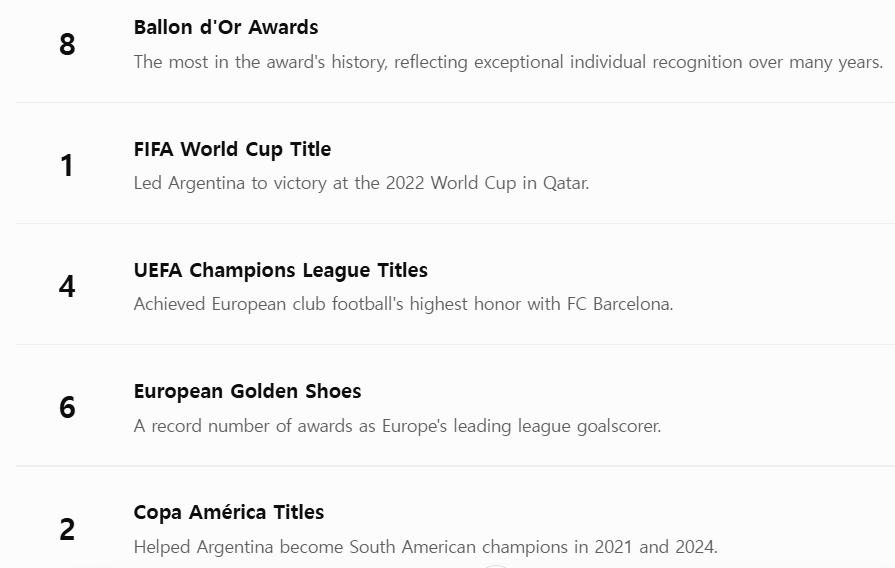
Helped Argentina become South American champions in 2021 and 2024.
Yet trophies alone do not adequately explain Messi’s place in football history.
His strongest claim to GOAT status comes from the rare combination of three qualities.
First, he is an extraordinary goalscorer who has consistently delivered elite finishing throughout his career.
Second, he is among the greatest dribblers football has ever witnessed.
Third, he possesses the passing vision and tactical intelligence of an elite playmaker.
Very few players in football history have combined all three abilities at such an exceptional level over such an extended period.
This versatility distinguishes Messi from players who have excelled primarily as scorers, creators, or individual attackers.
His career also demonstrates remarkable longevity.
He dominated European club football with Barcelona, achieved international glory with Argentina, and continued collecting individual and team honors after moving to the United States.
Of course, winning an MLS Golden Boot is not equivalent to winning the Champions League or performing at the highest level of the World Cup.
The leagues involve different levels of competition.
However, Messi’s GOAT credentials were established long before his arrival in Miami.
His achievements in MLS provide additional evidence of something equally remarkable: his ability to adapt, evolve, and remain decisive well beyond a conventional footballer’s peak.
6. The Evolution of Greatness: Messi at His Peak Versus Messi at 39
One of the most fascinating aspects of Messi’s career is how his playing style has changed.
The Messi of Barcelona’s golden era was capable of extraordinary acceleration, relentless close-control dribbling, and spectacular solo goals.
The Messi of 2026 operates differently.
He relies more heavily on anticipation, positioning, technical economy, and the selective use of energy.
| Category | Messi at His Barcelona Peak | Messi in 2026 |
|---|---|---|
| Speed | Explosive acceleration | Intelligent timing and movement |
| Dribbling | Frequent extended runs | Selective, efficient penetration |
| Playmaking | Dynamic creativity during attacking moves | Greater emphasis on controlling tempo |
| Goalscoring | High-volume scoring across attacking positions | Precision, positioning, and opportunity selection |
| Tactical influence | Directly destabilizing defenses | Dictating key attacking moments |
These differences should not be interpreted as evidence that Messi has retained all the physical abilities of his youth.
He has not.
Football places enormous demands on acceleration, endurance, defensive work, and repeated high-intensity movement.
Age inevitably affects these qualities.
Yet what makes Messi exceptional is his ability to compensate.
He increasingly uses his experience and anticipation to gain advantages that once depended more heavily on speed.
His movement is often economical rather than spectacular.
His passes are often calculated rather than elaborate.
And his goals are frequently products of superior positioning and precision rather than overwhelming physical force.
This evolution provides an important lesson in sporting greatness.
The truly exceptional athlete does not necessarily defeat time.
Instead, he adapts to it.
Messi’s transformation from explosive young genius to sophisticated veteran playmaker is one of the defining achievements of his career.
7. More Than Goals: Messi’s Lasting Legacy
Messi’s final regular-season match of 2026 offered a fitting illustration of his football philosophy.
On November 7, Inter Miami drew 3–3 with Charlotte FC.
Although Messi did not score, he supplied two assists from corner kicks for his team’s opening goals.
Even on the day his second consecutive Golden Boot was confirmed, his contribution was not limited to goalscoring.
He helped create opportunities for his teammates.
That is a central part of what makes Messi special.
Football is ultimately decided by goals, but its greatest players influence how those goals become possible.
They recognize opportunities others fail to see.
They change the positioning of defenders simply through their presence.
They improve the effectiveness of teammates and shape the rhythm of matches.
Messi has demonstrated these qualities throughout his career.
From the dazzling teenager who emerged at Barcelona to the experienced captain who led Argentina to the World Cup title, he has continually expanded the ways in which he influences a football match.
Now, at 39, he continues to produce outstanding results in a new league and a different football culture.
His 75 goals and 52 assists across three MLS regular seasons are more than impressive statistics.
They are evidence of sustained excellence.
Messi’s career illustrates that greatness is not measured solely by how spectacular an athlete can be at his physical peak.
It is also measured by how long that athlete can remain effective, how successfully he adapts, and how much he contributes to the achievements of his team.
Epilogue: The Football King Who Refuses to Fade Away
Lionel Messi’s second consecutive MLS Golden Boot in 2026 is more than another individual trophy.
It is another chapter in one of the most extraordinary careers in sporting history.
Twenty goals in 2024.
Twenty-nine goals in 2025.
Twenty-six goals in 2026.
Seventy-five goals and 52 assists over three seasons.
At an age when most footballers have already completed their careers, Messi continues to score, create, and compete at an exceptional level.
His career represents a rare combination of natural talent, technical perfection, tactical intelligence, competitive endurance, and adaptability.
He has achieved the highest honors in European club football, fulfilled Argentina’s dream of winning the World Cup, and established new standards of individual excellence in Major League Soccer.
The debate over football’s greatest player will continue, as it should.
Different generations have their heroes. Different styles of football inspire different judgments about greatness.
But Messi’s place among the sport’s immortals is beyond serious doubt.
He has delivered extraordinary performances across different stages of his career and has shown that footballing intelligence can remain a decisive weapon even as physical powers diminish.
The youthful Messi overwhelmed opponents with acceleration, dribbling, and improvisation.
The veteran Messi defeats them with patience, anticipation, precision, and experience.
The methods have changed.
The brilliance remains.
And perhaps that is the most compelling reason Messi deserves to be considered the greatest footballer of all time.
He has not merely enjoyed one glorious period of dominance.
He has continually reinvented greatness.
Time may have taken some of the speed from Lionel Messi’s legs, but it has never taken the genius from his footballing mind.
At 39, he is no longer simply reminding the world of what he once was. He is showing the world what true greatness looks like when experience becomes as powerful as talent.
Football history will remember many extraordinary champions. But few names will shine as brightly, or for as long, as Lionel Messi.


